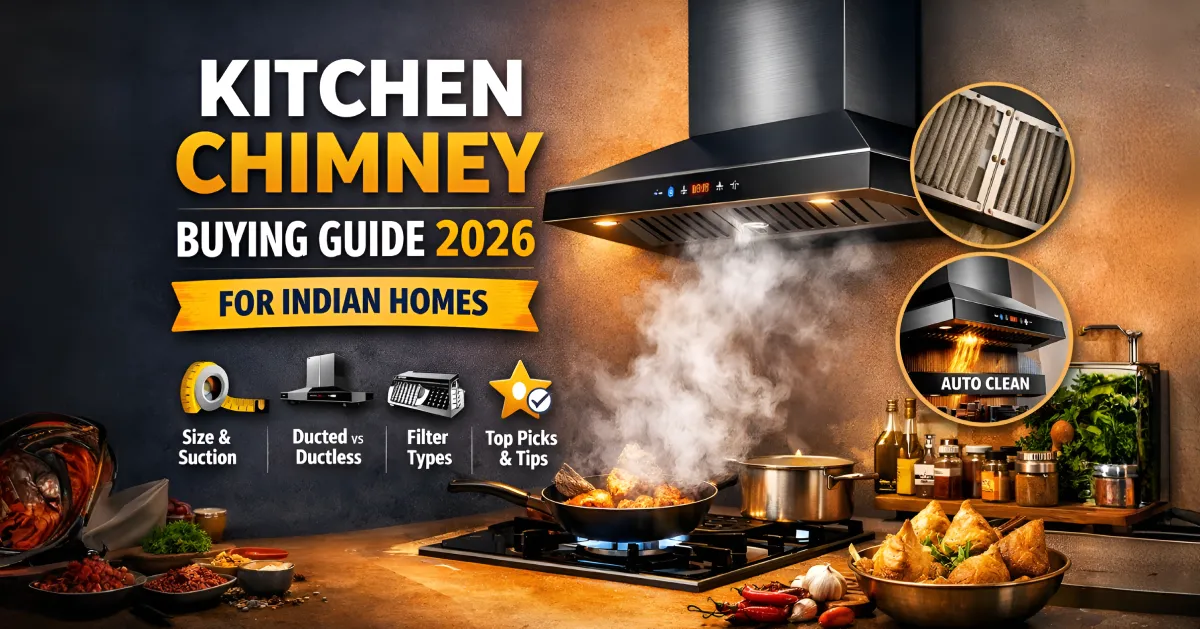
If you've ever walked into your kitchen after making a round of parathas or deep-frying pakoras and found the walls coated with a greasy film, you already know the struggle. Indian cooking—with its generous use of spices, oils, and high-heat techniques—produces smoke, steam, and airborne grease like no other cuisine. Your kitchen deserves better than smoky walls, lingering odors, and a constant battle with grime.
Enter the kitchen chimney: your kitchen's best defense against the chaos of Indian cooking.
But here's the challenge—walk into any appliance store or browse online, and you'll be bombarded with choices. Auto-clean, filterless, baffle filter, 1200 m³/hr, curved glass, wall-mounted, island… the list goes on. Which one do you actually need? What's worth your money, and what's just marketing fluff?
This guide cuts through the confusion. Whether you're setting up your first kitchen or upgrading from an old exhaust fan, we'll walk you through everything you need to know to choose the perfect kitchen chimney for your Indian home in 2026. Let's dive in.
Table of Contents
1. Why Indian Kitchens Absolutely Need a Chimney
Let's be honest—Indian cooking is intense. From tadka sputtering in hot oil to rotis puffing over open flames, our kitchens work overtime. Here's why a chimney isn't a luxury but a necessity:
The Real Problems Indian Kitchens Face:
Excessive Smoke & Grease: Traditional Indian cooking involves techniques like deep frying (samosas, pakoras), tempering with whole spices (tadka), and high-heat roasting. These processes release massive amounts of smoke and oil particles into the air.
Wall & Ceiling Damage: That yellowish-brown stain on your kitchen walls? It's a mixture of grease, soot, and condensed steam. Over time, this buildup damages paint, tiles, and even wooden cabinets.
Health Concerns: Prolonged exposure to cooking fumes—especially from deep frying—can irritate your respiratory system. Studies show that indoor air pollution from cooking can rival outdoor pollution levels in Indian cities.
Lingering Odors: Cooked fish curry yesterday? Your curtains, clothes, and even your living room remember. Without proper ventilation, cooking smells permeate every corner of your home.
Heat Buildup: Indian kitchens often have multiple burners running simultaneously—dal on one, sabzi on another, rotis on the third. This generates significant heat, making the kitchen uncomfortable.
What a Kitchen Chimney Does:
A good chimney tackles all these issues by:
- Sucking out smoke and steam before they spread to other rooms
- Capturing grease particles through filters or direct motor suction
- Reducing heat by improving air circulation
- Protecting your kitchen from stains and damage
- Improving air quality for healthier cooking
Bottom line: If you cook Indian food regularly (and let's be real, you do), a chimney isn't optional—it's essential.
2. How Kitchen Chimneys Work: The Basics
Before we dive into types and specifications, let's understand the mechanics. A kitchen chimney is essentially a powerful suction system mounted above your stove.
Core Components:
- Hood/Canopy: The visible part that sits above your cooking range. It's designed to capture rising smoke and fumes.
- Motor: The heart of the chimney. It creates suction by pulling air upward. Single-motor chimneys work for small kitchens; larger kitchens need double motors for adequate power.
- Filters (in some models):
- Baffle Filters: Stainless steel panels with curved channels that separate grease from air
- Cassette/Mesh Filters: Multiple layers of aluminum mesh (less efficient, outdated)
- Charcoal Filters: Used in ductless chimneys to absorb odors
- Ducting System (in ducted models): Pipes that carry the smoke outside through a hole in your kitchen wall or ceiling.
- Control Panel: Buttons, touch controls, or motion sensors to adjust suction speed and lighting.
- LED Lights: Illuminate your cooking area.
Two Operating Modes:
Ducted Mode (Recommended):
- Smoke is expelled outside through ducting
- More efficient for heavy Indian cooking
- Requires external ventilation hole
Ductless/Recirculation Mode:
- Air passes through charcoal filters and returns to the kitchen
- No external ducting needed
- Less effective for greasy Indian cooking
Pro Tip: Always opt for ducted installation if possible. Ductless chimneys struggle with the high grease and odor levels typical in Indian cooking.
3. Types of Kitchen Chimneys: Which Design Suits You?
Kitchen chimneys come in various designs and filter types. Let's break them down:
A. Based on Mounting Style
Wall-Mounted Chimney
Best for: Standard kitchens with stoves against a wall (90% of Indian homes)
Features:
- Attaches directly to the wall above your stove
- Available in 60 cm, 75 cm, and 90 cm widths
- Most common and affordable option
Price Range: ₹6,000 – ₹45,000
Ideal if: Your cooking range is positioned against a wall (most Indian kitchen layouts)
[Want to explore wall-mounted options? Check our detailed guide on the best wall-mounted chimneys for Indian kitchens]
Island Chimney
Best for: Modular kitchens with central cooking islands
Features:
- Suspended from the ceiling using support rods
- 360-degree design since it's visible from all sides
- Premium aesthetics, higher price point
Price Range: ₹35,000 – ₹1,50,000
Ideal if: You have an open-plan kitchen with a central island cooktop
Built-in/Integrated Chimney
Best for: Ultra-modern kitchens with concealed appliances
Features:
- Hidden inside kitchen cabinets
- Slides out when needed
- Space-saving, minimalist design
Price Range: ₹25,000 – ₹80,000
Ideal if: You prefer a clean, streamlined kitchen aesthetic
B. Based on Filter Type
This is where things get technical—and important.
Baffle Filter Chimney
How it works: Stainless steel curved panels that force grease-laden air to change direction multiple times. Grease particles hit the baffles and drip into a collection tray; clean air moves upward.
Pros: ✅ Highly effective for Indian cooking (handles heavy grease) ✅ Durable—stainless steel lasts years ✅ Dishwasher-safe filters ✅ Better suction efficiency
Cons: ❌ Requires manual filter cleaning every 2-3 months ❌ Slightly more expensive than cassette filters
Best for: Heavy daily cooking, especially frying and grilling
Price Range: ₹8,000 – ₹35,000
Our Take: This is the gold standard for Indian kitchens. If you cook regularly with oil and spices, go for baffle filters.
Auto-Clean Chimney
How it works: Uses heat or oil collector technology to automatically clean internal components. When activated, heating elements burn off grease deposits, which then drip into a collection cup.
Pros: ✅ Minimal manual cleaning (once every 6-12 months) ✅ Maintains suction efficiency longer ✅ Convenient for busy households ✅ Better hygiene—less grease buildup
Cons: ❌ Higher upfront cost ❌ Consumes extra electricity during auto-clean cycles ❌ Collection cup needs periodic emptying
Best for: Busy families who cook daily but don't want frequent maintenance hassles
Price Range: ₹10,000 – ₹50,000
Our Take: Worth the investment if you cook heavy Indian meals daily. The convenience pays for itself.
Top Models in 2026:
- Elica WD HS ORG FL 600 HAC (₹15,499)
- Faber Hood Crest Plus HC SC (₹14,000-₹18,000)
- Glen Auto Clean Curved Glass (₹10,495-₹11,995)
[Learn more about how auto-clean technology works in our detailed guide]
Filterless Chimney
How it works: No traditional filters at all. The motor directly sucks in smoke and expels it through ducting. Uses centrifugal force to separate grease, which collects in an oil cup.
Pros: ✅ Zero filter maintenance ✅ Maximum suction power (no filter blockage) ✅ Sleek, modern design ✅ Low ongoing maintenance
Cons: ❌ Expensive (₹15,000+) ❌ Motor gets exposed to grease (shorter lifespan if not cleaned) ❌ Collection cup needs weekly cleaning with heavy cooking ❌ Must be used in ducted mode—doesn't work well ductless
Best for: Moderate cooking with good ducting infrastructure
Price Range: ₹15,000 – ₹55,000
Our Take: Great if you have proper ducting and don't mind emptying the oil cup weekly. However, for heavy Indian cooking, baffle filter + auto-clean is more reliable.
Popular Models:
- Elica Filterless Series (₹15,000-₹25,000)
- Faber Filterless Models (₹18,000-₹30,000)
[Confused between filterless and auto-clean? Read our comparison guide]
Cassette/Mesh Filter Chimney
How it works: Multiple layers of aluminum mesh trap grease particles.
Pros: ✅ Cheapest option (₹5,000-₹12,000)
Cons: ❌ Poor efficiency—mesh clogs quickly ❌ Requires cleaning every 2-3 weeks ❌ Suction drops dramatically when dirty ❌ Outdated technology
Our Take: Avoid these. They were popular 10 years ago but are inadequate for Indian cooking. Baffle filters or auto-clean are far better investments.
C. Based on Design/Shape
Straight-Line/Flat Chimney
- Traditional box design
- Budget-friendly
- Good for compact kitchens
Curved Glass Chimney
- Elegant curved glass panel
- Easier to clean (smooth surface)
- Premium look without premium price
- Popular choice in 2026
Inclined/Angular Chimney
- Slanted design (saves head-bumping space)
- Modern aesthetics
- Better for taller users
- Slightly higher price
T-Shaped Chimney
- Vertical duct design
- Powerful suction
- Traditional look
Design Tip: Choose based on your kitchen aesthetics and cabinet height. Inclined chimneys work well in kitchens with low ceilings or upper cabinets close to the stove.
4. Understanding Key Specifications: What Really Matters
Now comes the technical stuff—but don't worry, we'll keep it simple.
A. Suction Power (m³/hr) — THE Most Important Spec
This tells you how much air the chimney can suck in one hour. For Indian cooking, this is your #1 priority.
Recommended Suction Power:
| Kitchen Size | Cooking Style | Minimum Suction Power |
|---|---|---|
| Small (< 100 sq ft) | Light cooking (boiling, steaming) | 1000 m³/hr |
| Small (< 100 sq ft) | Heavy cooking (frying, grilling) | 1200 m³/hr |
| Medium (100-150 sq ft) | Regular Indian cooking | 1200-1350 m³/hr |
| Large (150+ sq ft) | Heavy daily cooking | 1350-1600 m³/hr |
| Open Kitchen | Multi-burner cooking | 1500+ m³/hr |
Reality Check: Many brands advertise inflated suction numbers. Always check user reviews for actual performance.
Pro Tip: For typical Indian cooking (daily tadka, weekly deep frying, occasional grilling), 1200-1350 m³/hr is the sweet spot for most homes.
B. Chimney Size: Width Matters
Your chimney must be at least as wide as your cooking range—preferably 3-6 inches wider for maximum coverage.
Standard Sizes:
| Cooktop/Stove Size | Recommended Chimney Size |
|---|---|
| 2-burner stove | 60 cm chimney |
| 3-burner stove | 60 cm or 75 cm chimney |
| 4-burner stove | 75 cm or 90 cm chimney |
| 5-burner stove | 90 cm chimney |
Most Common: 60 cm chimneys work for 80% of Indian homes with standard 3-4 burner stoves.
Mistake to Avoid: Don't buy a 60 cm chimney for a 75 cm stove—smoke will escape from the sides.
C. Noise Level (dB)
A noisy chimney ruins your cooking experience (and annoys the entire household).
Acceptable Noise Levels:
- 45-58 dB: Quiet (normal conversation level) ✅
- 58-65 dB: Moderate (noticeable but acceptable)
- 65+ dB: Loud (annoying for extended cooking) ❌
What to Look For:
- Brands like Faber, Elica, and Bosch focus on silent operation
- Check for “Silent Drive Motor” or “Noise Reduction Technology”
- Read reviews—specs can lie, user experiences don't
D. Number of Motors
Single Motor:
- Adequate for small-medium kitchens
- 1000-1300 m³/hr capacity
- Most common in budget models
Dual Motor:
- For large kitchens or open layouts
- 1400-1600 m³/hr capacity
- Better for commercial-style cooking
For most homes: Single motor with 1200+ m³/hr suction is sufficient.
E. Control Panel Types
- Push Button: Traditional, reliable, budget-friendly
- Touch Control: Modern, sleek, easy to clean (glass surface)
- Motion Sensor: Hands-free operation (wave to control)
- Smart/App Control: Rare in India, mostly in premium models
Best Choice: Touch control offers the best balance of convenience and cleanability.
F. Power Consumption
Kitchen chimneys consume 150-300 watts on average.
- Running 2 hours daily = ~10-15 kWh/month
- Monthly electricity cost = ₹60-₹90 (at ₹6/kWh)
Energy-Saving Tip: Use lower speed settings when possible. Max speed is rarely needed except during heavy frying.
5. How to Choose the Right Chimney Based on YOUR Kitchen
Let's make this personal. Answer these questions:
Question 1: What's Your Kitchen Size?
Small Kitchen (< 100 sq ft):
- Recommended: 60 cm chimney, 1000-1200 m³/hr
- Type: Wall-mounted, auto-clean or baffle filter
- Budget: ₹8,000 – ₹15,000
- Top Picks: Glen 60 cm Auto Clean (₹10,495), Hindware Nadia 60 cm (₹9,500)
Medium Kitchen (100-150 sq ft):
- Recommended: 60-75 cm, 1200-1350 m³/hr
- Type: Wall-mounted, auto-clean
- Budget: ₹12,000 – ₹20,000
- Top Picks: Faber Hood Crest (₹14,000), Elica 60 cm Auto Clean (₹15,499)
Large/Open Kitchen (150+ sq ft):
- Recommended: 90 cm, 1350-1600 m³/hr
- Type: Island or wall-mounted, auto-clean or filterless
- Budget: ₹18,000 – ₹45,000
- Top Picks: Kaff 90 cm (₹25,000+), Faber 90 cm (₹22,000+)
Question 2: What's Your Cooking Style?
Light Cooking (Boiling, steaming, occasional frying):
- Suction needed: 1000-1200 m³/hr
- Filter type: Baffle filter (low maintenance)
- Budget: ₹7,000 – ₹12,000
Regular Indian Cooking (Daily sabzi, dal, weekly frying):
- Suction needed: 1200-1350 m³/hr
- Filter type: Auto-clean or baffle filter
- Budget: ₹10,000 – ₹18,000
Heavy Cooking (Daily frying, grilling, non-veg, multiple burners):
- Suction needed: 1350-1600 m³/hr
- Filter type: Auto-clean with baffle filters
- Budget: ₹15,000 – ₹30,000+
Question 3: What's Your Budget?
Under ₹10,000 (Budget-Friendly):
- Glen 60 cm Baffle Filter (₹8,998)
- Prestige 60 cm (₹8,500)
- Hindware Basic Models (₹7,000-₹9,500)
- Expect: Manual cleaning, basic features, adequate suction
[See our complete guide: Best Kitchen Chimneys Under ₹10,000]
₹10,000 – ₹15,000 (Mid-Range Sweet Spot):
- Glen Auto Clean 60 cm (₹10,495-₹11,995)
- Elica WDFL 606 HAC (₹12,499)
- Faber Entry-level Auto Clean (₹12,000-₹14,000)
- Expect: Auto-clean, touch control, good suction, decent build
[Check out: Best Kitchen Chimneys Under ₹15,000]
₹15,000 – ₹20,000 (Premium Performance):
- Elica Auto Clean Filterless (₹15,499-₹18,499)
- Faber Hood Crest Plus (₹16,998)
- Glen 90 cm Auto Clean (₹18,000+)
- Expect: Excellent suction, motion sensors, premium design, low noise
[Explore: Best Kitchen Chimneys Under ₹20,000]
₹20,000+ (Luxury Segment):
- Kaff Premium Models (₹25,000-₹60,000)
- Bosch Auto Clean Series (₹28,000+)
- Faber Premium 90 cm (₹25,000+)
- Expect: High-end features, smart controls, superior build quality, designer aesthetics
Question 4: Do You Have Ducting Infrastructure?
Yes, I have external ducting: ✅ Go for any chimney (ducted mode is most efficient) ✅ Filterless models work great ✅ Better for heavy cooking
No ducting, and can't make a wall opening: ⚠️ Choose ductless-capable models ⚠️ Must have charcoal filters ⚠️ Expect lower efficiency ⚠️ Not ideal for heavy frying
[Learn more: Ducted vs Ductless Chimneys—Which is Better?]
Question 5: Burner Configuration
2-Burner Stove:
- 60 cm chimney, 1000-1200 m³/hr
- [Best options: Kitchen Chimneys for 2-Burner Stoves]
3-Burner Stove:
- 60-75 cm chimney, 1200-1350 m³/hr
- [Best options: Kitchen Chimneys for 3-Burner Stoves]
4-Burner Stove:
- 75-90 cm chimney, 1350-1500 m³/hr
- [Best options: Kitchen Chimneys for 4-Burner Stoves]
6. Top Kitchen Chimney Brands in India (2026)
Here's a quick overview of the leading brands. Each has its strengths.
1. Elica 🇮🇹
Origin: Italy Known For: Filterless technology, motion sensors, sleek design Price Range: ₹12,000 – ₹48,000 Strengths: Quiet operation, advanced features, stylish Weaknesses: Service availability in tier-2/3 cities can be spotty Best For: Modern kitchens, tech-savvy buyers
Popular Models:
- Elica WDFL 606 HAC (₹15,499) — Auto-clean, 1200 m³/hr
- Elica EFL 3V (₹16,998) — Filterless, motion sensor
Service Centers: [Find Elica Service Center Near You]
[Read our detailed Elica Kitchen Chimney Review]
2. Faber 🇮🇹
Origin: Italy Known For: Powerful suction, durability, thermal auto-clean Price Range: ₹11,000 – ₹40,000 Strengths: High suction power (1200-1500 m³/hr), robust build, excellent for heavy cooking Weaknesses: Some models can be noisy Best For: Heavy Indian cooking, reliability seekers
Popular Models:
- Faber Hood Crest Plus HC SC (₹14,000-₹16,998)
- Faber 90 cm Auto Clean (₹22,000+)
[Complete Review: Faber Kitchen Chimneys—Worth the Hype?]
3. Glen 🇮🇳
Origin: India Known For: Value for money, wide service network Price Range: ₹7,000 – ₹25,000 Strengths: Affordable, good after-sales support, reliable performance Weaknesses: Design aesthetics are basic Best For: Budget-conscious buyers, tier-2/3 cities
Popular Models:
- Glen 6058 BL Auto Clean (₹10,495-₹11,995) — 1200 m³/hr
- Glen 60 cm Baffle Filter (₹8,998)
[Read: Glen Kitchen Chimney Review]
4. Hindware 🇮🇳
Origin: India Known For: Affordable, decent quality, pan-India service Price Range: ₹7,000 – ₹20,000 Strengths: Budget-friendly, reliable brand Weaknesses: Lower suction power in entry models Best For: First-time buyers, small kitchens
[Review: Hindware Kitchen Chimneys]
5. Kaff 🇮🇳
Origin: India Known For: Premium designs, high suction power Price Range: ₹11,000 – ₹1,75,000 Strengths: Powerful motors (up to 1600 m³/hr), stylish, commercial-grade Weaknesses: Expensive, overkill for small kitchens Best For: Luxury kitchens, heavy-duty cooking
6. Prestige 🇮🇳
Origin: India Known For: Trusted name, economical Price Range: ₹8,000 – ₹18,000 Strengths: Affordable, widely available Weaknesses: Basic features, moderate suction Best For: Budget buyers
[Review: Prestige Kitchen Chimneys]
7. Bosch 🇩🇪
Origin: Germany Known For: Ultra-quiet operation, premium quality Price Range: ₹20,000 – ₹50,000 Strengths: Silent Drive Motor, triple filtration, premium build Weaknesses: Expensive, limited models in India Best For: Premium segment buyers
Brand Comparison Table
| Brand | Suction Power | Price Range | Best Feature | Service Network |
|---|---|---|---|---|
| Elica | 1100-1400 m³/hr | ₹12,000-₹48,000 | Filterless tech | Good in metros |
| Faber | 1200-1500 m³/hr | ₹11,000-₹40,000 | High suction | Excellent |
| Glen | 1000-1300 m³/hr | ₹7,000-₹25,000 | Value for money | Excellent |
| Hindware | 1000-1350 m³/hr | ₹7,000-₹20,000 | Affordable | Excellent |
| Kaff | 1200-1600 m³/hr | ₹11,000-₹1,75,000 | Premium design | Good |
Our Take: For most Indian homes, Faber and Glen offer the best balance of performance, price, and service. If budget allows, Elica adds premium features.
[Deep Dive: Top 10 Kitchen Chimney Brands in India]
7. Installation & Maintenance: Getting It Right
Even the best chimney performs poorly if installed incorrectly.
Installation Guidelines
A. Height from Cooktop
Standard Rule: 24-30 inches (65-75 cm) above your gas stove
Detailed Recommendations:
- Gas Stove: 26-30 inches (higher to avoid flames reaching chimney)
- Induction Cooktop: 24-26 inches (no flames, can be lower)
- Heavy Indian Cooking: 26-28 inches (optimal capture zone)
Too Low (<24 inches): Risk of fire hazard, grease builds up faster Too High (>30 inches): Reduced suction efficiency, smoke escapes
B. Ducting Tips
Duct Diameter:
- 60 cm chimney: 6-inch (150 mm) duct
- 75-90 cm chimney: 8-inch (200 mm) duct
Ducting Best Practices: ✅ Use smooth, rigid aluminum ducts (better airflow than flexible pipes) ✅ Keep duct length under 10 feet (longer ducts reduce suction) ✅ Minimize bends—each 90° bend reduces efficiency by ~10% ✅ Duct opening should be on an exterior wall, not into a false ceiling ✅ Seal all duct joints with aluminum tape (prevent air leaks)
Cost: Ducting installation typically costs ₹2,000-₹5,000 depending on complexity.
[Complete Guide: Kitchen Chimney Ducting for Indian Homes]
C. Electrical Requirements
- Standard 15A power socket
- Should be within 3-4 feet of chimney
- Preferably behind upper cabinets (hidden wiring)
D. Professional Installation vs DIY
Professional Installation (Recommended):
- Cost: ₹500-₹1,500 (often free with purchase)
- Ensures correct height, proper ducting, secure mounting
- Warranty remains valid
DIY Installation:
- Saves ₹500-₹1,000
- Risk of incorrect installation
- May void warranty
Our Advice: Pay for professional installation. It's worth it.
[Step-by-Step: How to Install a Kitchen Chimney]
Maintenance Tips
Monthly Tasks:
For Baffle Filter Chimneys:
- Remove baffle filters (usually slides out)
- Soak in hot water + dishwashing liquid for 15 minutes
- Scrub with soft brush, rinse, air dry
- Reinstall
Time: 10-15 minutes
For Auto-Clean Chimneys:
- Run auto-clean cycle (press button, runs 5-10 minutes)
- Empty oil collection cup
- Wipe exterior with damp cloth
Time: 5 minutes
For Filterless Chimneys:
- Empty oil collection cup weekly
- Wipe internal surfaces with degreaser monthly
Time: 5 minutes
Every 6-12 Months:
- Deep clean internal motor housing (call technician or DIY with degreaser)
- Check ducting for blockages
- Inspect electrical connections
- Test suction performance
Service Cost: ₹800-₹1,500 for professional deep cleaning
[Read: Complete Kitchen Chimney Maintenance Guide]
Troubleshooting Common Issues
| Problem | Cause | Solution |
|---|---|---|
| Weak suction | Clogged filters | Clean filters |
| Loud noise | Loose parts, worn motor | Tighten screws, service motor |
| Oil dripping | Overflowing collection cup | Empty cup regularly |
| Auto-clean not working | Electrical issue, sensor fault | Check power, call service |
| Chimney not turning on | Power issue, blown fuse | Check socket, replace fuse |
[Detailed Guide: Kitchen Chimney Not Working? Troubleshooting Tips]
8. Common Mistakes to Avoid When Buying a Chimney
Learn from others' mistakes:
❌ Mistake #1: Choosing the Wrong Size
The Error: Buying a 60 cm chimney for a 75 cm stove.
The Result: Smoke escapes from the sides, defeating the purpose.
The Fix: Chimney width should match or exceed stove width by 3-6 inches.
❌ Mistake #2: Ignoring Suction Power
The Error: Buying based on looks or brand alone, ignoring m³/hr rating.
The Result: Inadequate smoke removal, especially during heavy cooking.
The Fix: Prioritize suction power (1200+ m³/hr for Indian cooking).
❌ Mistake #3: Skipping Professional Installation
The Error: DIY installation without proper tools or knowledge.
The Result: Incorrect height, poor ducting, reduced efficiency, warranty void.
The Fix: Invest ₹500-₹1,000 in professional installation.
❌ Mistake #4: Not Considering Kitchen Layout
The Error: Buying a ducted chimney when there's no provision for external ducting.
The Result: Chimney sits unused or performs poorly in ductless mode.
The Fix: Assess ducting feasibility before purchase.
❌ Mistake #5: Falling for “Too Good to Be True” Deals
The Error: Buying unknown brands at rock-bottom prices (₹3,000-₹4,000).
The Result: Poor build quality, weak suction, no service support, breaks within months.
The Fix: Stick to established brands. A ₹8,000-₹10,000 Glen/Hindware is far better than a ₹4,000 no-name brand.
❌ Mistake #6: Neglecting After-Sales Service
The Error: Buying a brand with no service centers in your city.
The Result: When issues arise, no support. DIY repairs void warranty.
The Fix: Check brand service availability in your area before buying.
❌ Mistake #7: Overlooking Noise Levels
The Error: Ignoring decibel ratings, focusing only on suction.
The Result: Unbearably loud operation during cooking.
The Fix: Check reviews for noise feedback. Aim for <60 dB models.
9. Frequently Asked Questions (FAQs)
Is a kitchen chimney necessary for Indian cooking?
Absolutely yes, especially if you cook daily. Indian cooking generates significantly more smoke, grease, and odor compared to Western cooking. A chimney protects your kitchen from damage, improves air quality, and makes cooking more comfortable.
Which is better—auto-clean or filterless chimney?
Auto-Clean Chimney:
📌 Better for heavy Indian cooking
📌 Baffle filters provide extra grease filtration
📌 Requires minimal maintenance (quarterly cleaning)
📌 More reliable long-term
Filterless Chimney:
📌 Maximum suction (no filter obstruction)
📌 Zero filter maintenance
📌 Requires weekly oil cup emptying
📌 Motor exposed to grease (needs careful maintenance)
Verdict: For typical Indian cooking, auto-clean with baffle filters is more reliable. Filterless works well if you have good ducting and don't mind weekly oil cup cleaning.
How much electricity does a kitchen chimney consume?
Average consumption is 150-300 watts.
Monthly Usage Calculation:
📌 2 hours daily × 30 days = 60 hours/month
📌 200W × 60 hours = 12 kWh/month
📌 At ₹6/kWh = ₹72/month
Cost Impact: Minimal—roughly the same as running two ceiling fans.
[Read More: Kitchen Chimney Electricity Consumption]
What suction power is ideal for Indian cooking?
1200-1350 m³/hr is ideal for most Indian homes with regular cooking.
📌 Light cooking: 1000-1200 m³/hr
📌 Regular Indian cooking: 1200-1350 m³/hr
📌 Heavy/commercial-style cooking: 1400-1600 m³/hr
Chimney vs exhaust fan—which is better?
Chimneys are far superior for Indian kitchens. Exhaust fans are inadequate for Indian cooking. Invest in a chimney.
Can I use a chimney without a duct?
Yes, but with limitations.
Ductless/Recirculation Mode:
📌 Air passes through charcoal filters and returns to kitchen
📌 50-60% less effective than ducted mode
📌 Charcoal filters need replacement every 6 months (₹800-₹1,200)
📌 Not recommended for heavy frying or Indian cooking
Our Advice: If possible, always install with ducting for optimal performance.
How often should I clean my chimney?
📌 Baffle Filters: Every 2-3 months (or monthly if you fry frequently)
📌 Auto-Clean: Run cycle monthly; deep clean every 6-12 months
📌 Filterless: Empty oil cup weekly; wipe internals monthly
📌 Professional Service: Once a year for deep cleaning
What is the lifespan of a kitchen chimney?
With proper maintenance:
📌 Budget brands (Hindware, Prestige): 5-7 years
📌 Mid-range (Glen, Faber, Elica): 8-10 years
📌 Premium (Bosch, Kaff): 10-15 years
Factors affecting lifespan: Maintenance frequency, cooking style, motor quality, filter care.
What warranty should I expect?
Standard Warranties:
📌 Motor: 5-10 years (most important)
📌 Product: 1-2 years comprehensive
📌 Filters: Usually not covered
Brands with Best Warranties:
📌 Faber: 7-10 year motor warranty
📌 Elica: 5-7 year motor warranty
📌 Glen: 5-10 year motor warranty
Pro Tip: Always register your product within 7 days of purchase to activate warranty.
Can I install a chimney myself?
Technically yes, but not recommended.
Challenges:
📌 Determining correct height
📌 Drilling through walls for ducting
📌 Securing mounting brackets on different wall types (brick, tile, drywall)
📌 Electrical wiring
📌 Risk of voiding warranty
Cost-Benefit: Save ₹500-₹1,000 but risk poor installation. Professional installation is worth it.
10. Final Thoughts: Making Your Decision
Choosing a kitchen chimney doesn't have to be overwhelming. Let's recap:
Your Quick Decision Framework:
Step 1: Measure Your Kitchen
- Small (< 100 sq ft) → 60 cm, 1000-1200 m³/hr
- Medium (100-150 sq ft) → 60-75 cm, 1200-1350 m³/hr
- Large (150+ sq ft) → 90 cm, 1350-1600 m³/hr
Step 2: Assess Your Cooking Style
- Light → 1000-1200 m³/hr
- Regular Indian → 1200-1350 m³/hr
- Heavy → 1350-1600 m³/hr
Step 3: Check Ducting Feasibility
- Can make wall opening → Go for any model (ducted mode)
- Cannot make opening → Choose ductless-capable models
Step 4: Set Your Budget
- ₹8,000-₹10,000: Glen/Hindware baffle filter
- ₹10,000-₹15,000: Glen/Elica auto-clean (best value)
- ₹15,000-₹20,000: Faber/Elica premium auto-clean
- ₹20,000+: Kaff/Bosch luxury segment
Step 5: Choose Filter Type
- Heavy cooking → Auto-clean with baffle filters
- Moderate cooking → Filterless (if good ducting)
- Budget-conscious → Baffle filter (manual cleaning okay)
Our Top Recommendations for 2026:
Best Overall Value: Glen 6058 BL Auto Clean (₹10,495-₹11,995)
- 1200 m³/hr, 60 cm, motion sensor, excellent service network
- [Check Latest Price on Amazon] | [Check on Flipkart]
Best for Heavy Cooking: Faber Hood Crest Plus HC SC (₹14,000-₹16,998)
- 1200 m³/hr, robust build, powerful suction, thermal auto-clean
- [Check Latest Price on Amazon] | [Check on Flipkart]
Best Premium Choice: Elica WD HS ORG FL 600 HAC (₹15,499)
- Filterless, 1200 m³/hr, motion sensor, ultra-sleek design
- [Check Latest Price on Amazon] | [Check on Flipkart]
Best Budget Pick: Hindware Nadia 60 cm (₹9,000-₹10,500)
- 1200 m³/hr, baffle filter, reliable performance
- [Check Latest Price on Amazon] | [Check on Flipkart]
Before You Buy: Final Checklist
✅ Kitchen size measured ✅ Stove width noted ✅ Ducting feasibility checked ✅ Budget finalized ✅ Brand service availability confirmed ✅ Suction power adequate (1200+ m³/hr) ✅ Installation cost factored in ✅ Reviews checked on Amazon/Flipkart ✅ Warranty terms understood
Ready to Transform Your Kitchen?
A kitchen chimney is more than an appliance—it's an investment in your kitchen's health, your home's cleanliness, and your family's well-being. The smoke, grease, and odors that once clung to your walls and lungs will be history.
Whether you're buying your first chimney or upgrading from an old exhaust fan, the choices in 2026 have never been better. With brands like Faber, Elica, and Glen pushing innovation while keeping prices reasonable, there's a perfect chimney for every Indian kitchen.
Don't let another month pass with smoke-stained walls and lingering curry smells. Your kitchen deserves better. Use this guide, make an informed decision, and enjoy the transformation.
Happy cooking! 🍳