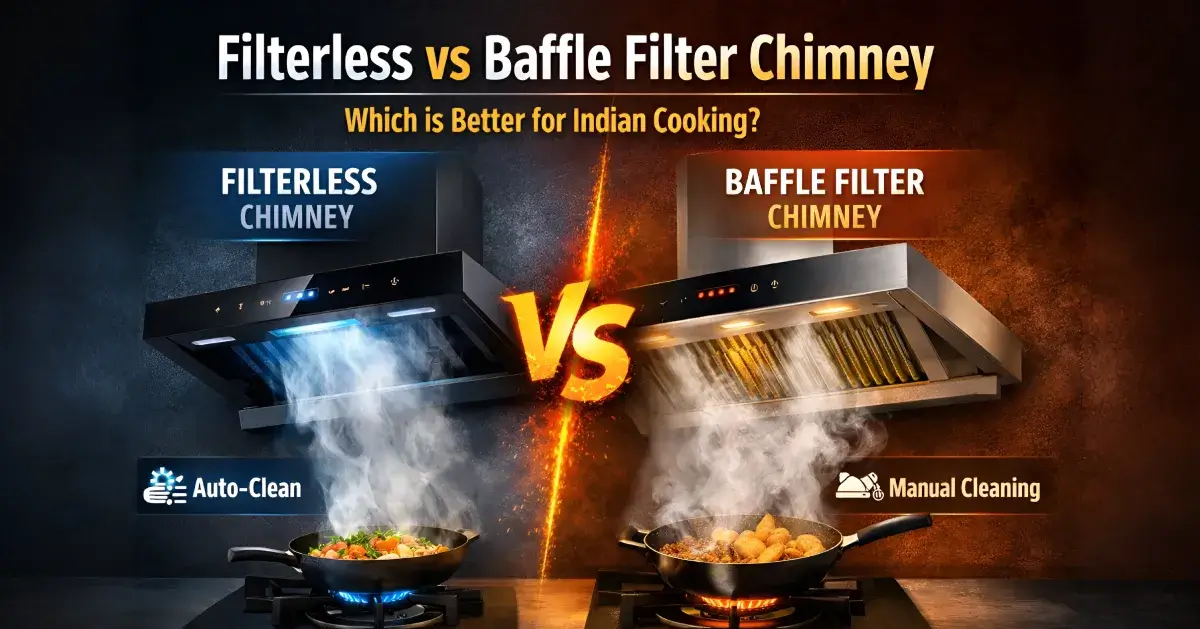

Choosing the right kitchen chimney filter type is one of the most confusing decisions for Indian homeowners. Many buyers struggle to understand whether a filterless chimney or a baffle filter chimney will perform better for their cooking style, kitchen size, and maintenance expectations.
Indian cooking typically involves high heat, deep frying, tadka, and heavy oil usage. Because of this, the chimney’s ability to handle grease, smoke, and strong odors becomes extremely important. The filter type you choose directly affects suction efficiency, cleaning effort, noise levels, and long-term durability.
While modern modular kitchens are increasingly adopting filterless technology, traditional baffle filter chimneys are still widely trusted for their rugged performance in demanding Indian cooking conditions.
Before we explore the detailed comparison, here is a quick expert verdict to help you understand which type may suit your needs.
⭐ Quick Verdict: Filterless vs Baffle Filter Chimney
If you are confused between a filterless chimney and a baffle filter chimney, here is a simple decision guide for Indian kitchens.
👉 Choose a Baffle Filter Chimney if:
- You do heavy frying, tadka, grilling or oily cooking daily
- You want a lower budget option
- You don’t mind periodic manual cleaning
- You prefer proven, durable technology
👉 Choose a Filterless Chimney if:
- You want low-maintenance performance
- You cook frequently but want easier cleaning
- You prefer modern auto-clean technology
- You are ready to spend slightly more for convenience
👉 For most modern Indian modular kitchens, filterless chimneys are becoming the preferred choice, while baffle filters still remain highly reliable for traditional heavy cooking.
🔶 What is a Baffle Filter Kitchen Chimney?
A baffle filter chimney uses multiple layers of curved metal plates to separate grease and smoke from the air while cooking.
When hot smoke from Indian cooking (like tadka, deep frying, or grilling) enters the chimney, the airflow changes direction inside these plates. This sudden change causes oil particles and grease to stick to the metal surfaces, while cleaner air continues to move upward and gets exhausted outside.
⭐ Why Baffle Filters Are Popular in India
Baffle filters are widely recommended for Indian kitchens because:
- They handle heavy oil and spice smoke better than basic mesh filters
- They are durable and long-lasting
- Cleaning is simple — usually done by washing with hot water or detergent
- They work effectively even with high suction power
✅ Key Advantages
✔ Strong performance during heavy frying and daily cooking
✔ Lower initial cost compared to advanced filterless models
✔ Suitable for both small and large kitchens
✔ Proven technology used for many years
⚠️ Limitations to Know
✖ Require manual cleaning every few weeks depending on usage
✖ Can become noisy if grease buildup increases
✖ Slightly less modern design compared to filterless chimneys
🔷 What is a Filterless Kitchen Chimney?
A filterless kitchen chimney does not use traditional metal filters to trap grease.
Instead, it uses advanced airflow technology (centrifugal separation) to push smoke and oil particles outward before expelling the air.
When cooking fumes enter the chimney, a powerful motor creates a high-speed airflow that forces heavier grease particles to move toward the inner walls of the chimney. These particles then flow down into an oil collector tray, while relatively cleaner air is exhausted outside.
This design reduces the need for frequent filter cleaning — which is why filterless chimneys are becoming very popular in modern Indian kitchens.
⭐ Why Filterless Chimneys Are Trending
- Designed for low maintenance convenience
- Usually come with auto-clean technology
- Offer a more sleek and modern design
- Suitable for busy families who cook daily but prefer easier upkeep
✅ Key Advantages
✔ No physical filters to remove and wash
✔ Lower maintenance effort compared to baffle filter chimneys
✔ Consistent suction performance when cleaned regularly
✔ Modern features like motion sensor, touch control, and digital display
⚠️ Limitations to Consider
✖ Generally more expensive than baffle filter models
✖ Performance depends on regular use of auto-clean function
✖ Some budget filterless models may not handle very heavy frying as efficiently as baffle filters
⚖️ Filterless vs Baffle Filter Chimney – Key Differences
Both filterless and baffle filter chimneys are designed to remove smoke and grease effectively, but they work in different ways and suit different cooking habits.
Here is a simple comparison to help you understand the practical differences in Indian kitchens.
| Feature | Baffle Filter Chimney | Filterless Chimney |
|---|---|---|
| Grease handling | Excellent for heavy oily cooking | Very good for moderate to heavy cooking |
| Maintenance effort | Needs manual cleaning every few weeks | Low maintenance – just empty oil collector |
| Initial cost | Usually more affordable | Slightly higher price range |
| Long-term performance | Very stable even with heavy frying | Depends on regular auto-clean usage |
| Noise level | Can increase if filters become greasy | Generally quieter and smoother airflow |
| Design & features | Traditional design options | Modern design with smart controls |
| Best suited for | Traditional Indian cooking & large families | Modular kitchens & busy lifestyles |
⭐ Practical Insight
- If your kitchen sees daily deep-frying or heavy spice cooking, a baffle filter chimney is still a very reliable choice.
- If you prefer convenience and modern features with less cleaning effort, a filterless chimney can be a better long-term solution.
🏠 When Should You Choose a Filterless or Baffle Filter Chimney?
Choosing between a filterless and a baffle filter chimney becomes easier when you match the technology with your real cooking habits, kitchen size, and lifestyle.
Here are some practical Indian kitchen scenarios to help you decide.
✅ Choose a Baffle Filter Chimney if:
- Your family cooks heavy oily food daily (deep frying, tadka, grilling, non-veg frying)
- You use multiple burners simultaneously
- You want a more budget-friendly option
- You don’t mind cleaning the filters manually every 3–4 weeks
- You prefer proven, long-lasting technology
👉 Baffle filters are especially suitable for joint families and traditional cooking styles, where smoke and grease levels are consistently high.
✅ Choose a Filterless Chimney if:
- You want minimum maintenance effort
- You prefer modern kitchen appliances with smart features
- Your cooking is moderate to heavy but not extreme daily frying
- You are comfortable using the auto-clean function regularly
- You want a sleek design for modular kitchens
👉 Filterless chimneys are ideal for urban apartments, working couples, and busy households where convenience is a priority.
⭐ Expert Tip
If you are unsure, choose a chimney based on how often you deep-fry or cook oily dishes.
Frequent frying → Baffle filter safer choice
Moderate cooking + convenience → Filterless more comfortable
Great 👍 let’s continue.
💰 Long-Term Cost & Maintenance: Filterless vs Baffle Chimney
While the purchase price is important, the real cost of a kitchen chimney is calculated over several years of use.
Maintenance effort, electricity usage, and cleaning frequency all affect the total ownership cost.
Let’s understand how both chimney types compare in the long run.
🔶 Baffle Filter Chimney – Long-Term Cost
A baffle filter chimney usually has a lower initial price, which makes it attractive for budget buyers.
However, it requires regular manual cleaning to maintain proper suction performance.
Typical maintenance pattern:
- Manual filter cleaning every 3–4 weeks
- Deep cleaning every 3–6 months
- Professional servicing once a year
Estimated long-term cost factors:
✔ Lower upfront investment
✔ Very durable metal filters (rarely need replacement)
✔ Slightly higher effort and time spent on cleaning
✔ Performance remains stable even after many years
👉 Over 5 years, the total cost remains moderate, mainly involving cleaning effort rather than expensive parts.
🔷 Filterless Chimney – Long-Term Cost
Filterless chimneys usually have a higher initial price, but they reduce manual cleaning effort significantly.
Typical maintenance pattern:
- Run auto-clean cycle once a month
- Empty oil collector tray regularly
- Professional servicing once a year
Estimated long-term cost factors:
✔ Saves time and effort on cleaning
✔ Slightly higher electricity usage during auto-clean cycle
✔ Consistent performance if maintained properly
✔ Modern motors (like BLDC) can reduce power consumption
👉 Over 5 years, filterless chimneys often provide better convenience value, especially for busy households.
⭐ Practical Verdict
- If you want lowest purchase cost and don’t mind cleaning, baffle filters are economical.
- If you value time-saving convenience and modern features, filterless chimneys offer better overall experience.
❗ Common Myths About Filterless and Baffle Filter Chimneys
Many buyers get confused because of marketing claims and incomplete information.
Understanding the truth behind these common myths can help you make a smarter purchase decision.
🔶 Myth 1: “Filterless Chimneys Don’t Need Any Cleaning”
Reality:
Filterless chimneys reduce manual cleaning, but they still need regular maintenance.
You must:
- Run the auto-clean cycle periodically
- Empty and wash the oil collector tray
- Get professional servicing once a year
Without maintenance, grease can still affect suction performance.
🔶 Myth 2: “Baffle Filters Are Outdated Technology”
Reality:
Baffle filters are still one of the most reliable solutions for Indian cooking.
They handle heavy oil and spice smoke extremely well and are widely used in both residential and commercial kitchens.
Many modern chimneys even combine baffle filters with auto-clean technology for better convenience.
🔶 Myth 3: “Higher Suction Always Means Better Performance”
Reality:
Suction power is important, but proper installation, duct size, and regular cleaning matter just as much.
A poorly installed high-suction chimney may perform worse than a well-maintained moderate-suction model.
🔶 Myth 4: “Filterless Chimneys Are Always Better Than Baffle Filters”
Reality:
There is no single best option for every kitchen.
- Heavy daily frying → Baffle filter may perform better
- Moderate cooking + convenience → Filterless may be better
The right choice depends on cooking habits, kitchen layout, and maintenance preference.
⭐ Key Takeaway
Instead of choosing based on marketing terms, always evaluate:
✔ Your cooking intensity
✔ Maintenance comfort
✔ Kitchen size
✔ Budget
❓ FAQ: Filterless vs Baffle Filter Kitchen Chimney
Here are some common questions buyers ask before choosing between filterless and baffle filter chimneys.
1. Which chimney is better for heavy Indian cooking?
For heavy daily cooking that involves deep frying, tadka, grilling, or oily dishes, baffle filter chimneys are usually more effective.
They trap grease efficiently and maintain stable suction even under intense usage.
2. Are filterless chimneys suitable for small kitchens?
Yes. Filterless chimneys work well in small and medium-sized kitchens, especially when cooking intensity is moderate.
They are also ideal for modular kitchens where users prefer low maintenance and modern design.
3. How often should I clean a baffle filter chimney?
Typically, baffle filters should be cleaned once every 3–4 weeks, depending on cooking frequency.
Regular cleaning ensures better suction performance and longer motor life.
4. Do filterless chimneys completely remove the need for cleaning?
No. While they reduce manual cleaning, you still need to:
➢ Run the auto-clean cycle periodically
➢ Empty the oil collector tray
➢ Schedule annual professional servicing
Proper maintenance is essential for both chimney types.
5. Which chimney lasts longer — filterless or baffle?
Both types can last many years with proper maintenance.
Durability depends more on motor quality, usage habits, and servicing, rather than filter type alone.
6. Is a filterless chimney worth the higher price?
If convenience and time-saving are important to you, then yes.
Filterless chimneys offer easier maintenance and modern features, which many urban households prefer.
⭐ Filterless vs Baffle Filter Chimney — Which Should You Choose?
Choosing between a filterless chimney and a baffle filter chimney ultimately depends on your cooking style, maintenance preference, and budget.
Both technologies are effective for Indian kitchens — but they serve slightly different needs.
✅ Choose a Baffle Filter Chimney if:
- You cook heavy oily food daily
- You frequently use multiple burners at the same time
- You want a more affordable option
- You are comfortable with regular manual cleaning
- You prefer proven, long-lasting performance
👉 This type is ideal for traditional Indian households and joint families where cooking intensity is high.
✅ Choose a Filterless Chimney if:
- You want low maintenance and modern convenience
- You cook regularly but prefer less manual cleaning
- You like advanced features like auto-clean, motion sensor, and touch control
- You are ready to invest slightly more for ease of use
- You have a modular or urban apartment kitchen
👉 This option is perfect for busy families, working professionals, and modern kitchens.
⭐ Expert Recommendation
For most Indian homes today:
- Heavy frying + traditional cooking → Baffle filter is safer and more practical
- Moderate cooking + convenience preference → Filterless is more comfortable long term
Instead of focusing only on technology, choose a chimney that matches:
✔ Kitchen size
✔ Cooking frequency
✔ Suction requirement
✔ Service availability
✔ Budget
Making a practical decision based on real usage will ensure better performance and longer appliance life.