
🏠 Why Suction Power Matters More Than You Think
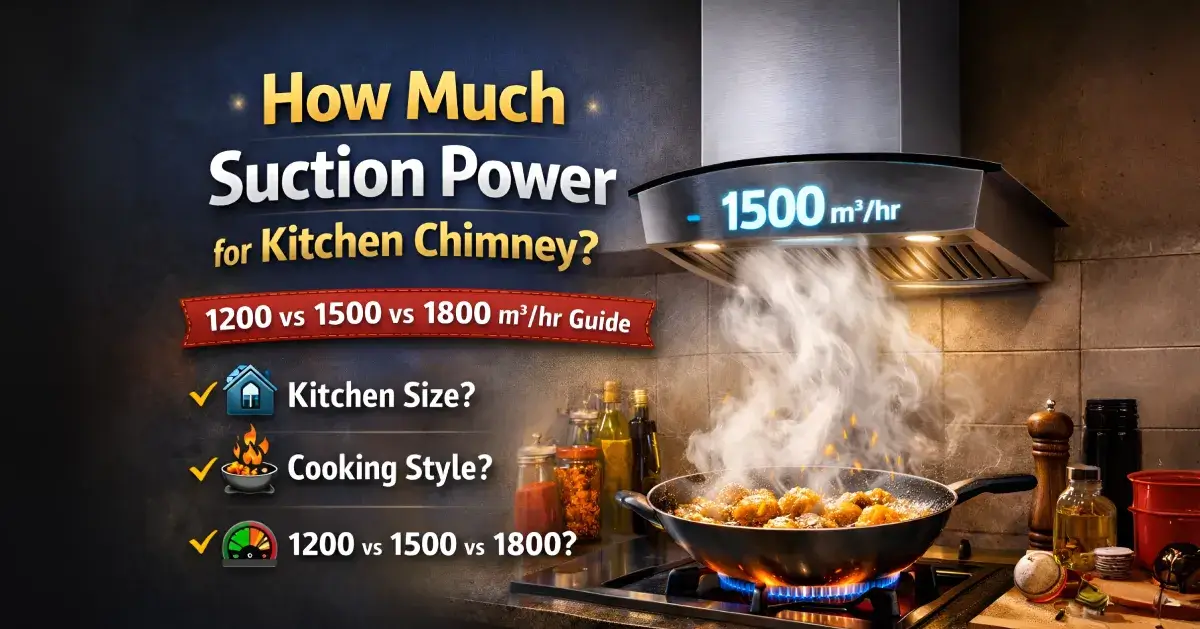
When buying a kitchen chimney, most people focus on price, brand, or design — but the most important factor that actually determines performance is suction power (measured in m³/hr).
If the suction power is too low:
❌ Smoke won’t be removed properly
❌ Oil particles will stick to cabinets
❌ Kitchen will feel hot and greasy
If it’s too high:
❌ Unnecessary noise
❌ Higher electricity usage
❌ Wasted money
👉 That’s why choosing the right suction power based on your kitchen and cooking style is critical.
⚡ What You’ll Learn in This Guide
In this article, we’ll break it down simply:
✔ What suction power actually means
✔ How much suction you need based on kitchen size
✔ Suction requirements for Indian cooking
✔ 1200 vs 1500 vs 1800 m³/hr comparison
✔ Common mistakes buyers make
⭐ Quick Insight
There is no “one perfect suction power” for everyone.
👉 The right choice depends on:
- Kitchen size
- Cooking frequency
- Type of food (light vs heavy frying)
- Duct length and layout
🔍 What is Suction Power in a Kitchen Chimney?
Suction power refers to how much air a kitchen chimney can pull in and expel per hour. It is measured in cubic meters per hour (m³/hr).
👉 In simple terms:
Suction power = how quickly and effectively your chimney can remove smoke, heat, and grease from your kitchen.
🧠 Easy Example to Understand
Imagine your kitchen fills with smoke while cooking.
- A low suction chimney (900 m³/hr) removes smoke slowly
- A high suction chimney (1500 m³/hr) clears smoke much faster
👉 The higher the suction power, the faster your kitchen becomes clean and smoke-free.
⚡ Why Suction Power Matters
Choosing the right suction directly affects:
✅ 1. Smoke Removal
Higher suction ensures smoke is captured before it spreads.
✅ 2. Oil & Grease Control
Strong airflow pulls oil particles efficiently, reducing sticky surfaces.
✅ 3. Kitchen Temperature
Good suction removes hot air, keeping your kitchen cooler.
✅ 4. Overall Air Quality
Prevents odor buildup and improves cooking comfort.
⚠️ Important Truth (Most Buyers Don’t Know)
👉 Higher suction is NOT always better
- Too high suction → more noise + unnecessary cost
- Too low suction → poor performance
✔ The goal is to choose the right balance based on your kitchen
⭐ Practical Insight
For Indian cooking (tadka, frying, spices):
👉 You generally need higher suction than Western kitchens
📏 Suction Power Based on Kitchen Size
The size of your kitchen plays a major role in deciding how much suction power you actually need.
👉 Larger kitchens produce more smoke spread → need higher suction 👉 Smaller kitchens → lower suction is sufficient
📊 Recommended Suction by Kitchen Size
| Kitchen Size | Recommended Suction Power | Suitable For |
|---|---|---|
| Small Kitchen (≤ 100 sq ft) | 900 – 1200 m³/hr | 1–2 burner, light cooking |
| Medium Kitchen (100–200 sq ft) | 1200 – 1400 m³/hr | 2–3 burner, daily cooking |
| Large Kitchen (200+ sq ft) | 1400 – 1600+ m³/hr | 3–5 burner, heavy cooking |
🔹 1. Small Kitchens (≤ 100 sq ft)
- Compact apartments
- Limited cooking space
👉 900–1200 m³/hr is enough
✔ Lower noise ✔ Energy efficient ✔ Cost-effective
🔹 2. Medium Kitchens (100–200 sq ft)
- Most Indian households
- Regular cooking
👉 1200–1400 m³/hr is ideal
✔ Balanced performance ✔ Handles daily cooking easily
🔹 3. Large Kitchens (200+ sq ft)
- Open kitchens
- Multiple burners
- Heavy cooking
👉 1400–1600+ m³/hr recommended
✔ Faster smoke removal ✔ Better coverage
⭐ Important Tip
If you have an open kitchen connected to living room:
👉 Always choose higher suction than recommended
⭐ Practical Insight
Most Indian homes fall into:
👉 1200–1400 m³/hr range (sweet spot)
🍳 Suction Power Based on Cooking Style
Kitchen size is important — but in India, your cooking style matters even more when choosing suction power.
Because:
👉 Indian cooking = more oil, smoke, spices, and heat
📊 Recommended Suction by Cooking Type
| Cooking Style | Recommended Suction Power | Examples |
|---|---|---|
| Light Cooking | 900 – 1200 m³/hr | Boiling, steaming, reheating |
| Moderate Cooking | 1200 – 1400 m³/hr | Daily meals, occasional frying |
| Heavy Cooking | 1400 – 1600+ m³/hr | Deep frying, tadka, grilling |
🔹 1. Light Cooking (Low Smoke)
If your cooking mostly involves:
- Boiling
- Steaming
- Simple dishes
- Minimal oil
👉 900–1200 m³/hr is sufficient
✔ Quiet operation ✔ Lower electricity usage ✔ Budget-friendly
🔹 2. Moderate Cooking (Most Indian Homes)
If you:
- Cook daily
- Do occasional frying
- Use 2–3 burners
👉 1200–1400 m³/hr is ideal
✔ Balanced performance ✔ Handles most Indian cooking comfortably
🔹 3. Heavy Cooking (High Smoke & Oil)
If your kitchen regularly involves:
- Deep frying (pakoras, pooris, fish, chicken)
- Strong tadka (oil + spices)
- Multiple burners at once
👉 1400–1600+ m³/hr is recommended
✔ Fast smoke removal ✔ Better grease control ✔ Keeps kitchen cleaner
⭐ Expert Insight
If your cooking includes frequent frying, always choose:
👉 At least 1400 m³/hr, even for medium kitchens
⚡ Real-Life Tip
Many buyers make this mistake:
👉 Choosing suction based only on kitchen size
✔ Always combine:
Kitchen size + Cooking style = Correct suction power
⚔️ 1200 vs 1500 vs 1800 m³/hr – Which Suction Power is Best?
When buying a kitchen chimney, you’ll commonly see models with:
👉 1200 m³/hr 👉 1500 m³/hr 👉 1800 m³/hr (or higher)
But which one should you choose?
Let’s break it down simply.
📊 Quick Comparison Table
| Suction Power | Best For | Pros | Cons |
|---|---|---|---|
| 1200 m³/hr | Small–medium kitchens | Affordable, quieter | Not ideal for heavy cooking |
| 1500 m³/hr | Most Indian homes | Balanced performance | Slightly higher price |
| 1800+ m³/hr | Large/open kitchens | Powerful, fast cleaning | More noise, higher cost |
🔹 1200 m³/hr – Budget & Basic Use
👉 Suitable for:
- Small to medium kitchens
- Light to moderate cooking
- 2–3 burner stoves
✔ Advantages
- Lower cost
- Less noise
- Energy efficient
✖ Limitations
- Struggles with heavy frying
- Not ideal for 4–5 burner setups
🔹 1500 m³/hr – Best Overall Choice ⭐
👉 Suitable for:
- Most Indian households
- Medium to large kitchens
- Daily cooking with occasional heavy frying
✔ Advantages
- Excellent balance of power and noise
- Handles Indian cooking well
- Works for 3–4 burner stoves
✖ Limitations
- Slightly higher cost than 1200 m³/hr
👉 This is the “sweet spot” for 80% of buyers
🔹 1800+ m³/hr – High Power / Premium Use
👉 Suitable for:
- Large kitchens
- Open kitchen layouts
- Heavy daily cooking
- 4–5 burner stoves
✔ Advantages
- Very fast smoke removal
- Ideal for heavy cooking
- Best for open spaces
✖ Limitations
- Higher noise levels
- More expensive
- Overkill for small kitchens
⭐ Expert Recommendation
- Small kitchen → 1200 m³/hr
- Most homes → 1500 m³/hr (best choice)
- Large/open kitchen → 1800+ m³/hr
⚡ Practical Insight
Buying too high suction thinking “more is better” is a mistake.
👉 Choose based on actual need, not just numbers.
⚠️ Common Mistakes When Choosing Chimney Suction Power
Many buyers end up with the wrong chimney simply because they misunderstand how suction power works.
Avoid these common mistakes to make a smarter decision.
🔶 1. Choosing Very High Suction “Just to Be Safe”
The mistake: Buying 1800 m³/hr for a small kitchen thinking “more is better”.
The problem:
- Unnecessary noise
- Higher electricity usage
- Wasted money
👉 The fix: Choose suction based on your actual kitchen size + cooking style
🔶 2. Ignoring Cooking Style
The mistake: Selecting suction based only on kitchen size.
The problem:
- Heavy frying produces much more smoke
- Low suction fails during peak cooking
👉 The fix: Always consider how often you fry or cook oily food
🔶 3. Ignoring Duct Length & Layout
The mistake: Not considering duct pipe length and bends.
The problem:
- Longer ducts reduce effective suction
- Multiple bends decrease airflow
👉 The fix: If duct is long or has bends → choose higher suction
🔶 4. Choosing Based Only on Brand or Price
The mistake: Buying popular brands without checking specs.
The problem:
- Even good brands offer low-suction models
- Performance may not match your needs
👉 The fix: Always check m³/hr rating first
🔶 5. Not Matching Chimney Size with Suction
The mistake: Using low suction for larger chimneys (like 90 cm).
The problem:
- Smoke escapes from edges
- Poor coverage
👉 The fix:
- 60 cm → 1000–1200 m³/hr
- 90 cm → 1400+ m³/hr
🔶 6. Ignoring Maintenance
The mistake: Not maintaining chimney regularly.
The problem:
- Grease buildup reduces suction
- Performance drops over time
👉 The fix: Regular cleaning = consistent performance
⭐ Key Takeaway
The right suction is not about the highest number.
👉 It’s about the right match for your kitchen and cooking habits
❓ FAQ: Kitchen Chimney Suction Power
Here are the most common questions people have when choosing chimney suction power.
1. What is the ideal suction power for Indian kitchens?
For most Indian homes:
👉 1200–1500 m³/hr is ideal
This range handles:
➢ Daily cooking
➢ Moderate frying
➢ 2–4 burner stoves
For heavy cooking or open kitchens, go for 1500–1800+ m³/hr.
2. Is 1200 m³/hr suction enough?
Yes, if:
➢ You have a small to medium kitchen
➢ Cooking is light to moderate
➢ Limited frying
👉 Not ideal for heavy daily frying or large kitchens.
3. Is higher suction always better?
No.
Higher suction can lead to:
➢ More noise
➢ Higher cost
➢ Unnecessary power consumption
👉 Always choose based on actual requirement, not maximum number.
4. Which suction is best for a 4-burner stove?
👉 Recommended: 1400–1600 m³/hr
This ensures:
➢ Proper smoke coverage
➢ Efficient removal from all burners
5. Does duct length affect suction performance?
Yes.
➢ Longer duct → lower effective suction
➢ More bends → reduced airflow
👉 For longer duct setups, choose higher suction chimney
6. What suction is best for open kitchens?
👉 1500–1800+ m³/hr
Open kitchens need stronger suction to prevent smoke from spreading into living areas.
7. Does suction power affect noise?
Yes.
➢ Higher suction → usually higher noise
➢ However, BLDC motor models are quieter even at high suction
⭐ Quick Summary
- Small kitchen → 900–1200 m³/hr
- Most homes → 1200–1500 m³/hr
- Large/open kitchen → 1500–1800+ m³/hr
⭐ What Suction Power Should You Choose?
Choosing the right suction power is all about matching your kitchen and cooking habits — not just picking the highest number.
🎯 Simple Recommendation (Easy to Remember)
- Small kitchen + light cooking → 900–1200 m³/hr
- Most Indian homes → 1200–1500 m³/hr (Best Choice)
- Large / open kitchen + heavy cooking → 1500–1800+ m³/hr
🧠 Expert Recommendation
For most buyers in India:
👉 1200–1500 m³/hr is the perfect balance
It offers:
✔ Strong performance for daily cooking ✔ Reasonable noise levels ✔ Good value for money ✔ Suitable for 2–4 burner stoves
⚡ When to Go for Higher Suction
Choose 1500+ m³/hr if:
- You cook heavy oily food daily
- You have a 4–5 burner stove
- Your kitchen is large or open
- Your duct length is long or has multiple bends
❗ When NOT to Choose High Suction
Avoid overpowered models if:
- You have a small kitchen
- Cooking is light
- You prefer quieter operation
👉 Otherwise, you’ll pay more for no real benefit.
⭐ Final Takeaway
The best chimney is not the one with the highest suction —
👉 It’s the one that fits your kitchen size + cooking style + installation setup
Make the right choice, and your kitchen will stay:
✔ Smoke-free ✔ Cleaner ✔ More comfortable