
✅ Go Ducted if you cook Indian food daily (tadka, deep frying, heavy masala), have an external wall access, and own your home. ✅ Go Ductless if you live in a rented flat, have no external wall access, cook lightly, or are on a strict budget.
Still not sure? Read the full guide — by the end, you'll know exactly which one suits your kitchen.
Table of Contents
Why This Decision Matters More Than You Think
When most Indians buy a kitchen chimney, they focus on brand, suction power, and price. But one crucial decision often gets overlooked — ducted or ductless?
This single choice affects:
- How clean your kitchen actually stays (not just looks clean)
- Your indoor air quality over months and years
- How much you'll spend on maintenance over a 5–10 year period
- Whether the chimney is even effective for Indian cooking
Indian cooking — with its high-heat tadkas, pakora frying, and smoky grilling — generates 3–4x more smoke, steam, and airborne grease than typical Western cooking. This means the ducted vs ductless decision hits harder here than almost anywhere else in the world.
In this guide, we break down everything: how each type works, real-world performance in Indian kitchens, installation costs, 5-year running costs, ideal use cases, and a clear verdict for every buyer type.
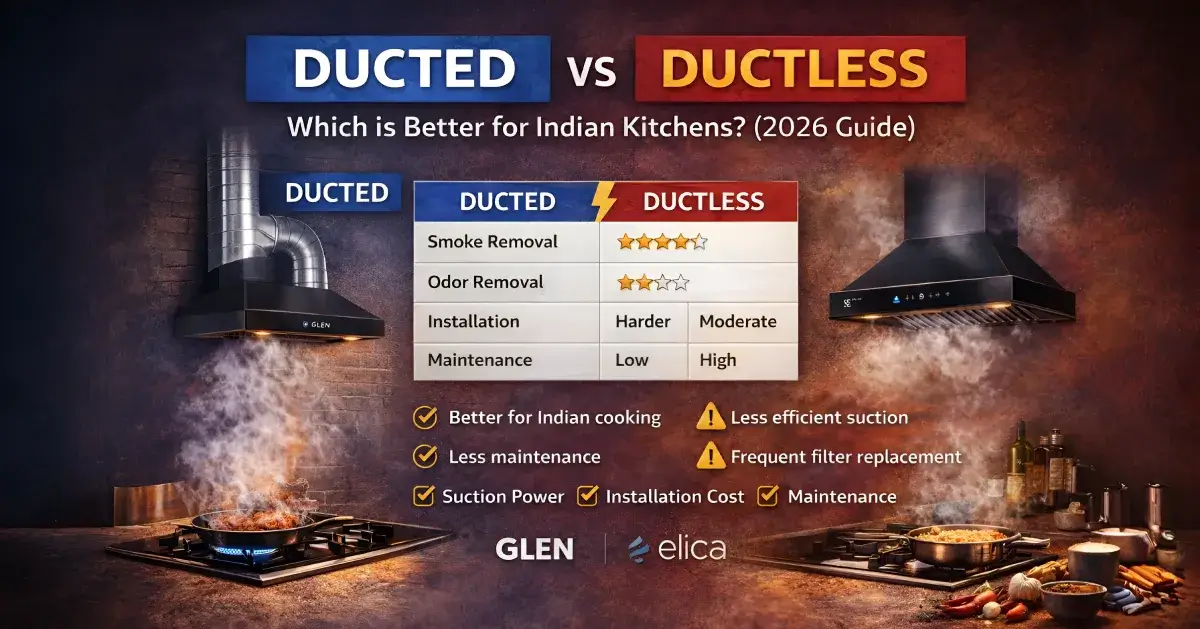
| Feature | Ducted | Ductless |
|---|---|---|
| Smoke Removal | ⭐⭐⭐⭐⭐ | ⭐⭐ |
| Odor Removal | Excellent | Moderate |
| Installation | Harder | Easy |
| Maintenance | Low | High |
| Best For | Indian Cooking | Rental Homes |
How Ducted and Ductless Chimneys Actually Work
How a Ducted (Vented) Chimney Works
A ducted chimney — also called a vented chimney — uses a motor to suck smoke, steam, grease, and odors completely out of your kitchen through a rigid or flexible duct pipe. The contaminated air travels through a 6–8 inch diameter aluminum duct, exits via a hole cut in your external wall, and disperses outside.
The air flow path: Hood captures smoke → Motor pulls air upward → Grease trapped in baffle/filter → Air exits through duct pipe → Out through wall vent/cowl
Key characteristic: The polluted air is permanently removed from the kitchen. Your kitchen gets fresh air in return (through gaps, doors, and windows).
How a Ductless (Recirculating) Chimney Works
A ductless chimney — also called a recirculation chimney — draws smoke and air inward, passes it through a series of filters (baffle/mesh filter + activated charcoal/carbon filter), and returns the cleaned air back into the kitchen.
The air flow path: Hood captures smoke → Motor pulls air through mesh/baffle filter (traps grease) → Air passes through activated charcoal filter (traps odors) → Cleaned air released back into kitchen
Key characteristic: The air is recirculated and filtered, not expelled. Your kitchen retains the same volume of air — just cleaner.
The Core Difference: Removal vs. Recirculation
This is the fundamental difference — and it explains almost everything else in this comparison.
| Aspect | Ducted Chimney | Ductless Chimney |
|---|---|---|
| What happens to smoke? | Expelled permanently outdoors | Filtered & recirculated indoors |
| Grease handling | Trapped in baffle/filter before duct | Trapped in mesh + charcoal filter |
| Odor handling | Removed completely | Reduced by ~60–70% (not eliminated) |
| Heat removal | ✅ Yes — hot air exits | ❌ No — heat stays in kitchen |
| Steam removal | ✅ Yes — completely | ❌ No — moisture stays in kitchen |
| Air quality | ✅ Truly fresh air | ⚠️ Filtered air (some pollutants remain) |
| Long-term wall/ceiling staining | Minimal (grease exits) | More (recirculated micro-particles settle) |
Head-to-Head Comparison: 10 Key Parameters
1. 🌬️ Suction Efficiency & Performance
Ducted: The chimney operates at its rated suction capacity (1200, 1350, 1500 m³/hr) because nothing blocks the airflow path. Grease is captured by filters, and clean air moves freely through the duct.
Ductless: Charcoal filters create airflow resistance, reducing effective suction by 30–50% compared to the rated capacity. A 1200 m³/hr ductless chimney may deliver only 600–840 m³/hr of real suction at the cooking surface.
Real-World Implication: Your ductless chimney rated at 1200 m³/hr may perform like a 700 m³/hr ducted model — which is why smoke often escapes a ductless chimney during heavy Indian cooking.
Winner: 🏆 Ducted (by a significant margin)
2. 🍳 Performance for Indian Cooking Specifically
Indian cooking is characterized by:
- High-flame cooking (pressure cooker hissing, wok frying)
- Heavy oil and spice use (tadka, deep frying, grilling)
- Strong aromas (garlic, mustard seeds, asafoetida, curry leaves)
- Prolonged cooking sessions (60–90 minutes vs. 20–30 minutes in the West)
A ducted chimney handles all of this with ease. A ductless chimney struggles particularly with:
- Odor elimination — charcoal filters can reduce but not fully remove masala smells.
- Steam and moisture — recirculated steam makes the kitchen humid and sticky.
- Heavy grease loads — charcoal filters saturate quickly with Indian cooking grease.
Expert Opinion (Houzz India): “Ducted chimneys are more effective and preferred for Indian-style cooking. The suction power removes contaminated air more efficiently and is better suited to the high-heat, high-oil nature of Indian meals.”
Expert Opinion (Atomberg): “A duct chimney has the upper hand in performance. If you are not bothered about high steam or kitchen temperature, you can go with a ductless chimney.”
Winner: 🏆 Ducted (strongly recommended for Indian cooking)
3. 🔧 Installation: Process, Difficulty & Cost
Ducted Installation:
- Requires 6-inch hole drilled through external wall.
- Aluminum or PVC duct pipe runs from chimney to outside vent.
- Must keep duct under 10 feet, with minimal bends (each 90° bend reduces suction by ~10%).
- Professional installation mandatory (voiding warranty if DIY in most brands).
- Requires electrician for 15A socket (for BLDC models).
Ducted Installation Cost Breakdown (2026):
| Component | Cost (₹) |
|---|---|
| Professional labor | 500 – 1,500 |
| Core cutting (wall hole) | 2,000 – 3,000 |
| Aluminum duct pipes (per meter) | 300 – 500 |
| Duct bends & clamps | 200 – 400 |
| External wall cowl/vent cap | 300 – 600 |
| Total Additional Cost | ₹3,000 – ₹6,000 |
Ductless Installation:
- No wall drilling or hole cutting required.
- Mount chimney on wall → plug into standard 5A socket → done.
- Can be DIY-installed in most cases.
- Ideal for apartments, rented homes, or kitchens far from external walls.
Ductless Installation Cost:
| Component | Cost (₹) |
|---|---|
| Professional labor (optional) | 500 – 800 |
| Charcoal filter (included in most models) | 0 (first set) |
| Total Additional Cost | ₹500 – ₹800 |
Winner: 🏆 Ductless (much simpler and cheaper to install)
4. 💰 Purchase Price
Both ducted and ductless models are available across all price ranges. However, some ductless chimneys are slightly cheaper at entry level because they don't include premium ducting-compatible motor specs.
| Segment | Ducted Price Range | Ductless Price Range |
|---|---|---|
| Budget | ₹5,000 – ₹9,000 | ₹4,500 – ₹8,500 |
| Mid-Range | ₹10,000 – ₹18,000 | ₹9,000 – ₹16,000 |
| Premium | ₹18,000 – ₹45,000+ | ₹16,000 – ₹40,000+ |
Verdict: Price difference is marginal (₹500–₹1,500). The bigger difference is installation cost — ducted costs ₹3,000–₹6,000 more upfront.
Winner: 🏆 Ductless (slightly lower purchase + installation cost)
5. 🔁 Ongoing Maintenance & Running Costs
This is where the real long-term cost difference emerges.
Ducted Chimney Maintenance:
- Baffle/mesh filters: Clean every 2–3 months (DIY, free).
- Annual professional motor service: ₹800–₹1,500/year.
- No filter replacements needed (filters are permanent stainless steel).
- Duct pipe inspection every 2–3 years.
Annual maintenance cost: ₹800–₹1,500
Ductless Chimney Maintenance:
- Mesh/baffle filter: Clean every 1–2 months (more frequent — higher grease load).
- Charcoal/carbon filter replacement every 3–6 months: ₹800–₹1,200 per set.
- Annual professional service: ₹800–₹1,500/year.
Annual maintenance cost: ₹2,400–₹4,200 (₹1,600–₹2,700 more per year than ducted)
📊 5-Year Total Cost Comparison
| Cost Component | Ducted (₹) | Ductless (₹) |
|---|---|---|
| Chimney purchase (mid-range) | 12,000 | 11,000 |
| Installation | 4,000 | 600 |
| Annual service × 5 | 6,000 | 6,000 |
| Charcoal filter replacement × 5 yrs | 0 | 8,000 – 12,000 |
| Total 5-Year Cost | ₹22,000 | ₹25,600 – ₹29,600 |
Key Insight: Ducted chimneys are ₹3,600–₹7,600 cheaper over 5 years — despite higher upfront installation cost.
Winner: 🏆 Ducted (significantly cheaper long-term)
6. 🌡️ Heat & Humidity Removal
Ducted: Expels hot, steamy air completely outside. Your kitchen stays 10–15°C cooler during cooking, which matters enormously in Indian summers.
Ductless: Recirculates the same hot, humid air. Charcoal filters don't reduce temperature or moisture. Your kitchen remains hot and steamy — leading to:
- Faster wall paint peeling.
- Mold/fungus growth near kitchen sinks and windows.
- Discomfort during long cooking sessions (especially May–July).
Winner: 🏆 Ducted (especially important in Indian climate)
7. 🏠 Suitability by Home Type
| Home Type | Best Choice | Reason |
|---|---|---|
| Owned apartment (metro) | Ducted | Can drill wall, permanent solution |
| Rented apartment | Ductless | No wall damage, portable |
| Independent house/villa | Ducted | Easy wall access, best performance |
| High-rise flat (upper floors) | Ducted (if possible) or Ductless | Duct feasibility depends on building rules |
| Builder flat (under construction) | Ducted | Plan ducting during construction (cheapest) |
| Old home (thick walls, no external wall access) | Ductless | Drilling not possible |
| PG / temporary accommodation | Ductless | No permanent modification needed |
Pro Tip for Renters: Always check your rental agreement. Some societies allow wall drilling with landlord permission and proper restoration. If allowed, ducted is strongly preferred even in rented homes.
8. 🔇 Noise Levels
Ducted: Motor works at optimal efficiency — less strain, lower noise. Typical range: 48–62 dB.
Ductless: The motor must work harder to push air through the resistance of charcoal filters. This results in 3–8 dB higher noise levels compared to the same motor in ducted mode.
| Mode | Typical Noise (dB) | Perception |
|---|---|---|
| Ducted | 48–58 dB | Quiet to moderate |
| Ductless | 55–65 dB | Moderate to loud |
Winner: 🏆 Ducted (quieter due to lower motor strain)
9. 🌿 Environmental Impact
Ducted: Expels cooking fumes outside — which contributes to outdoor air pollution marginally. However, this is generally acceptable in well-ventilated residential areas.
Ductless: Keeps all pollutants inside (even after filtering, some fine particulates and VOCs remain). Long-term indoor air quality may be slightly lower.
Winner: 🤝 Draw (ducted slightly better for indoor air; ductless slightly better for outdoors in dense urban areas)
10. 🔄 Flexibility & Portability
Ducted: Permanent installation. Cannot be relocated easily (duct hole remains in wall).
Ductless: Can be unmounted and reinstalled in a new home. Perfect for renters who move every 2–3 years.
Winner: 🏆 Ductless (portable, flexible)
Complete Head-to-Head Summary Table
| Parameter | Ducted | Ductless | Winner |
|---|---|---|---|
| Suction efficiency | 100% of rated | 50–70% of rated | 🏆 Ducted |
| Indian cooking performance | Excellent | Fair | 🏆 Ducted |
| Odor removal | 100% | 60–70% | 🏆 Ducted |
| Grease capture | Excellent | Good | 🏆 Ducted |
| Heat/steam removal | ✅ Complete | ❌ None | 🏆 Ducted |
| Installation cost | ₹3,000–₹6,000 | ₹500–₹800 | 🏆 Ductless |
| Purchase price | Slightly higher | Slightly lower | 🏆 Ductless |
| 5-year total cost | ~₹22,000 | ~₹25,600–29,600 | 🏆 Ducted |
| Maintenance effort | Low | Higher | 🏆 Ducted |
| Noise level | 48–58 dB | 55–65 dB | 🏆 Ducted |
| Renter-friendly | ❌ No | ✅ Yes | 🏆 Ductless |
| Portability | ❌ Fixed | ✅ Movable | 🏆 Ductless |
| Heat reduction | ✅ Significant | ❌ None | 🏆 Ducted |
| Long-term wall protection | Better | Average | 🏆 Ducted |
Overall Score: Ducted 10–4 Ductless
Who Should Choose Ducted? (Ideal Buyer Profile)
✅ Choose a Ducted Chimney If:
- You own your home (apartment or independent house).
- You cook 2–3 meals daily with frying, tempering, or grilling.
- Your kitchen has access to an external wall within 10 feet of the chimney.
- You want the best long-term value (cheaper over 5+ years despite higher upfront cost).
- You want truly fresh air — not recirculated air.
- You're building a new kitchen (plan ducting during construction — saves ₹2,000–₹3,000).
- You fry pakoras, poori, parathas, fish, or chicken regularly.
⚠️ Ducted May Not Work If:
- Your kitchen has no access to an external wall (e.g., inner city apartment, specific floor plan).
- Building society rules prohibit wall drilling.
- You're in a rented accommodation and can't make permanent modifications.
- Your duct run would exceed 15 feet or require more than 3 bends (drastically reduces suction).
Who Should Choose Ductless? (Ideal Buyer Profile)
✅ Choose a Ductless Chimney If:
- You live in a rented apartment and cannot drill walls.
- Your kitchen is located far from external walls (island kitchen, inner wall location).
- You cook light to moderate meals (2–3 times/day, limited deep frying).
- You're on a tight installation budget (saves ₹3,000–₹5,000 upfront).
- You move homes frequently (ductless chimney is portable).
- Society rules prohibit wall drilling or external vent installation.
⚠️ Ductless Limitations to Accept:
- You will need to replace charcoal filters every 3–6 months (₹800–₹1,200 per set).
- Expect some residual kitchen odor after heavy cooking.
- Your kitchen will stay warmer and more humid during cooking.
- You'll need slightly higher suction (1200+ m³/hr rated) to compensate for filter resistance.
The Duct Pipe: Aluminum vs. PVC — Which Should You Choose?
If you go ducted, your installer will use one of two pipe types.
| Parameter | Aluminum Duct Pipe | PVC Duct Pipe |
|---|---|---|
| Heat resistance | ✅ Excellent (up to 300°C) | ⚠️ Moderate (up to 60°C) |
| Fire safety | ✅ Non-combustible | ⚠️ Can melt/burn |
| Durability | 15–20 years | 5–8 years |
| Grease buildup | Less (smooth interior) | More (rough interior) |
| Cost (per meter) | ₹300–₹500 | ₹150–₹250 |
| Flexibility | Rigid/semi-rigid | More flexible |
| Recommended for India | ✅ Yes — strongly | ⚠️ Only for short runs |
Our Recommendation: Always use aluminum duct pipes for kitchen chimney installation.
Pro tip from Contractor Bhai: “Ductable chimneys channel out smoke through PVC or aluminum pipes. Aluminum is preferred because it does not melt, unlike PVC which can degrade over time due to cooking heat.”
Ducted Chimney: Installation Tips for Indian Homes
If you've decided on ducted — follow these tips to ensure maximum performance.
1. Plan During Construction (If Possible)
If your kitchen is under construction or renovation, plan the duct route before tiling the walls. This saves ₹2,000–₹3,000 in core cutting and avoids retiling.
2. Keep Duct Length Under 10 Feet
Every foot of duct reduces effective suction by 5–8%. A 12-foot duct on a 1200 m³/hr chimney delivers only ~960–1,080 m³/hr actual suction.
Optimal duct setup:
- Length: 6–10 feet (ideal)
- Diameter: 6 inch for 60 cm chimneys; 8 inch for 75/90 cm chimneys
- Bends: Maximum 2 bends (each 90° bend = 10% suction loss)
- Material: Rigid aluminum preferred over flexible corrugated
3. Install an External Cowl/Vent Cap
Always cap the external opening with a gravity-operated cowl (butterfly flap). This:
- Prevents backflow of outside wind.
- Keeps insects/birds from entering the duct.
- Reduces kitchen draft in winter.
Cost: ₹300–₹600.
4. Seal All Duct Joints
Use aluminum foil tape (not regular tape) to seal all duct joints. Unsealed joints reduce suction and allow grease to drip onto walls.
5. Hire a Brand-Authorized Technician
Most brands void warranties for non-authorized installation. Check brand website for technician list. Official installation costs ₹500–₹1,500 (often free with Croma/Amazon).
Best Ducted Chimneys for Indian Kitchens (2026)
| Model | Price (₹) | Suction | Best For | Buy Link |
|---|---|---|---|---|
| Glen 6058 BL Auto Clean | 10,495–11,995 | 1200 m³/hr | Best overall value | Amazon \ Flipkart |
| Elica WDFL 600 BLDC | 14,990–16,490 | 1500 m³/hr | Premium/heavy cooking | Amazon \ Flipkart |
| Faber Hood Crest Plus HC SC | 13,990–14,999 | 1200 m³/hr | Daily deep frying | Amazon \ Flipkart |
| Hindware Divina BLDC 60 | 12,499–14,999 | 1400 m³/hr | Energy efficiency | Amazon \ Flipkart |
| Faber Hood Crest Pro 60 | 15,990–17,154 | 1250 m³/hr | Feature-rich mid-range | Amazon \ Flipkart |
Best Ductless Chimneys for Indian Apartments (2026)
| Model | Price (₹) | Suction (Rated) | Charcoal Filter Life | Best For | Buy Link |
|---|---|---|---|---|---|
| Glen 6079 60 cm Ductless | 8,499–9,990 | 1000 m³/hr | 6 months | Budget apartments | Amazon \ Flipkart |
| Faber Spark Pro 3D BK FT 90 | 14,990–16,999 | 1095 m³/hr | 6 months | Mid-range flats | Amazon \ Flipkart |
| Beyond Appliances Cube Pro | 22,000–25,500 | 1400 m³/hr | 4 years (!) | Premium ductless | Amazon \ Flipkart |
| Elica WDFL 606 HAC | 12,499–14,499 | 1200–1350 m³/hr | 3–6 months | Brand-conscious buyers | Amazon \ Flipkart |
| Hindware Nadia Auto Clean | 9,499–10,999 | 1200 m³/hr | 3–6 months | Budget + brand trust | Amazon \ Flipkart |
💡 2026 Innovation Spotlight: The Beyond Appliances Cube Pro is India's first “Plug & Play” chimney with a 5-stage charcoal filter that lasts 4 years (vs. 3–6 months for standard filters). Replacement filter costs ₹2,000 (inclusive of installation). This dramatically changes the ductless maintenance cost equation — making it a serious contender for renters who cook regularly.
Can You Convert a Ductless Chimney to Ducted (and Vice Versa)?
Ductless → Ducted: Yes, Usually Possible
Most chimney models support both ducted and ductless modes. To convert to ducted:
- Remove the charcoal filter (if installed).
- Attach a duct pipe to the chimney's exhaust port.
- Route the duct to the external wall.
- Hire a professional for core cutting and cowl installation.
Cost: ₹3,000–₹5,500 (core cutting + duct pipe + cowl + labor).
This is a smart approach for renters who later buy their own home — start ductless, convert to ducted when you move to your owned flat.
Ducted → Ductless: Yes, Easy
To convert ducted to ductless:
- Cap the duct pipe opening.
- Install a charcoal filter kit (brand-specific, ₹800–₹1,500).
- Plug in and use.
Cost: ₹800–₹1,500 (charcoal filter kit only).
Many brands (Faber, Glen, Elica) include ductless kits in the box. Check before buying — it adds flexibility for the future.
Frequently Asked Questions (FAQ)
1. Is ductless chimney really effective for Indian cooking?
Honest Answer: Partially. A ductless chimney with 1200+ m³/hr rated suction will handle light to moderate Indian cooking reasonably well — it will reduce (not eliminate) smoke and absorb most odors.
However, for daily heavy cooking (deep frying, strong tempering), expect:
➢ Some smoke escaping during peak cooking.
➢ Residual masala/fish/garlic odor after cooking.
➢ Kitchen remaining hot during sessions.
If you cook lightly (boiling, stir-frying, occasional frying), ductless is adequate.
2. How often must I replace charcoal filters in a ductless chimney?
For Indian cooking, every 3–4 months (more aggressive cooking = faster saturation). Some premium brands (Beyond Appliances Cube Pro) claim 4-year filter life with their advanced multi-stage system.
Signs you need replacement:
➢ Persistent cooking odors even with chimney running.
➢ Visible darkening/saturation of filter.
➢ Reduced suction feeling despite motor running.
3. My building society doesn't allow wall drilling. What are my options?
You have three options:
➢ Go ductless — no drilling required.
➢ Route the duct upward through false ceiling and out via the terrace (complex, requires professional, costs ₹8,000–₹15,000).
➢ Use a plug-and-play chimney like Beyond Appliances Cube Pro — no drilling, high-performance 1400 CMH ductless.
4. Does ducted chimney increase electricity bills?
No. Both ducted and ductless chimneys use the same motor wattage (150–250W for standard models, 100–150W for BLDC). The electricity consumption difference is negligible.
However, in ductless mode, the motor works harder against filter resistance — potentially consuming 5–10% more electricity over time compared to the same motor in ducted mode.
5. Is the suction power rating on the box for ducted or ductless mode?
Always for ducted mode (free airflow, no resistance). The actual suction in ductless mode is 30–50% lower due to charcoal filter resistance. This is why you should choose a chimney with higher rated suction if you plan to use it in ductless mode.
Rule: If a ducted chimney needs 1200 m³/hr for your kitchen, a ductless chimney needs 1600–1800 m³/hr to deliver equivalent real performance.
6. Can I use a ducted chimney without a duct (no filter mode)?
Never do this. Without either a duct outlet or a charcoal filter, the chimney will:
➢ Suck in grease and deposit it directly on the motor (causes motor failure within months).
➢ Spread fine grease particles throughout your kitchen (worse than no chimney).
➢ Void your warranty immediately.
Always use your chimney in one of the two modes — ducted (with duct) or ductless (with charcoal filter).
7. I'm building a new home. What's the best way to plan chimney ducting?
Plan the duct route before tiling the kitchen. Here's the ideal sequence:
1. Decide chimney placement on wall.
2. Plan duct route to external wall (shortest path, fewest bends).
3. Have builder leave a 6-inch core-cut hole during construction.
4. Run aluminum duct pipe and cap externally before tiling.
5. Connect chimney at the end.
Cost benefit: This approach costs just ₹1,500–₹2,000 vs. ₹4,000–₹6,000 for post-construction ducting.
8. Which brands offer both ducted and ductless modes in India?
Almost all major brands do — Glen, Faber, Elica, Hindware, Kaff, Prestige, Inalsa. Always check the product page or box for “Convertible” or “Duct/Ductless” mode mention.
⭐ Our Expert Recommendation:
For 90% of Indian homes, a ducted chimney is the best long-term choice if installation is possible.
Our Final Recommendation
For Indian Kitchens, Ducted is the Clear Winner — When Possible
If you have access to an external wall and own your home, always choose ducted. The performance gap for Indian cooking is real and significant, and you save money over 5+ years despite the higher upfront installation cost.
But Ductless Has a Legitimate Place
For renters, those in high-rises with restricted drilling, or those with no external wall access, ductless is a perfectly valid choice — provided you:
- Choose a model with 1200+ m³/hr rated suction (to compensate for filter resistance).
- Replace charcoal filters every 3–4 months religiously.
- Accept that kitchen will remain warmer and slightly more aromatic during heavy cooking.
The Smart Strategy for Renters
Buy a chimney that supports both modes (most do). Install ductless now. When you move to your own home, spend ₹3,000–₹5,500 to convert to ducted mode. This way you get:
- Flexibility now.
- Full performance later.
- No need to buy a new chimney.
Related Guides (Internal Links)
- 🔗 Ultimate Kitchen Chimney Buying Guide 2026 ← Start here
- 🔗 Best Kitchen Chimney Under ₹15,000 in India (2026)
- 🔗 Best Kitchen Chimney Under ₹10,000 in India (2026)
- 🔗 Best Auto Clean Kitchen Chimney in India (2026)
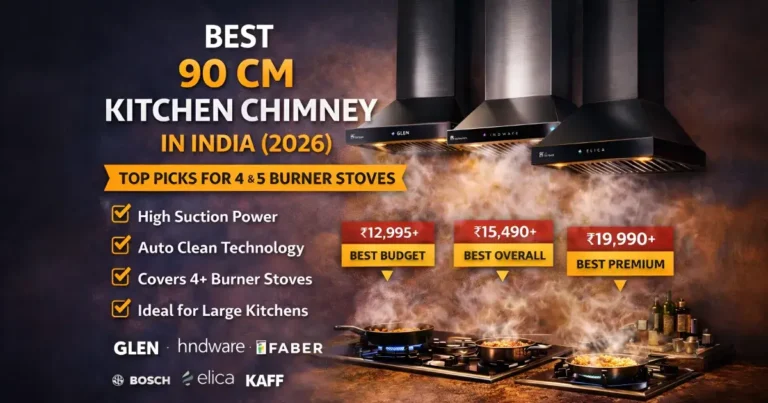
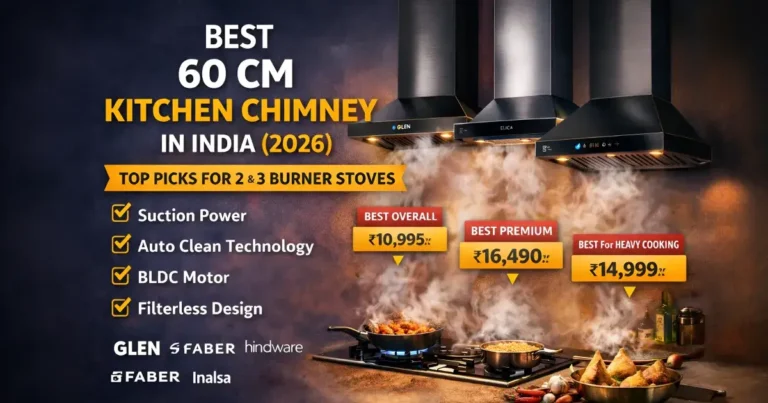
- 🔗 Best 60 cm Kitchen Chimney in India (2026)
Affiliate Disclosure
This post contains affiliate links to Amazon India and Flipkart. If you purchase through these links, we may earn a small commission at no additional cost to you. Prices mentioned are as of January 2026 and are subject to change. Always verify current pricing on the retailer's website before purchasing.
SOURCE: