
If you are comparing chimney vs exhaust fan power consumption, the short answer is simple:
An exhaust fan usually uses less electricity than a kitchen chimney in terms of raw wattage.
But that does not automatically mean it is the better choice for Indian kitchens.
A kitchen chimney normally consumes more power because it has a stronger motor, higher suction, filters, lights, and sometimes auto-clean functions. An exhaust fan is a simpler appliance, so its wattage is usually much lower.
However, electricity use should not be judged by wattage alone. You also need to look at:
- how long the appliance runs
- how effectively it removes smoke and grease
- whether it has multiple speed settings
- whether it gets left on longer than necessary
- whether you are using a standard or BLDC chimney
So if your only question is “Which one consumes less electricity?”, the answer is usually the exhaust fan.
If your question is “Which one gives better kitchen ventilation for the electricity used?”, the answer often shifts in favour of the chimney, especially for regular Indian cooking.
Does a chimney consume more electricity than an exhaust fan?
Yes. A kitchen chimney usually consumes more electricity because it uses a stronger motor and higher suction, but it also provides much better smoke and grease removal.
Quick Answer
Here is the easiest way to understand it:
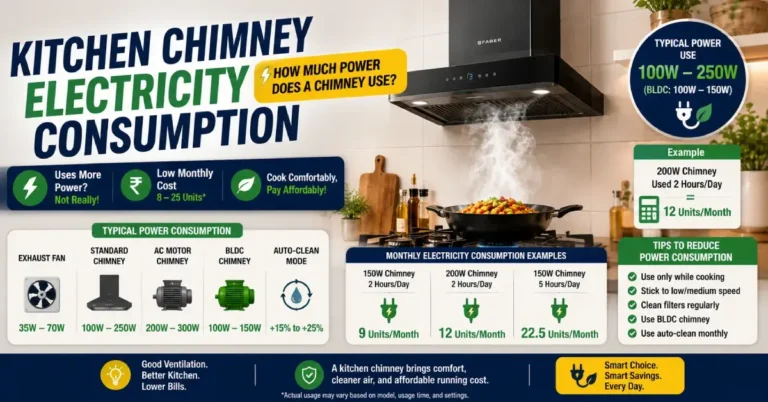
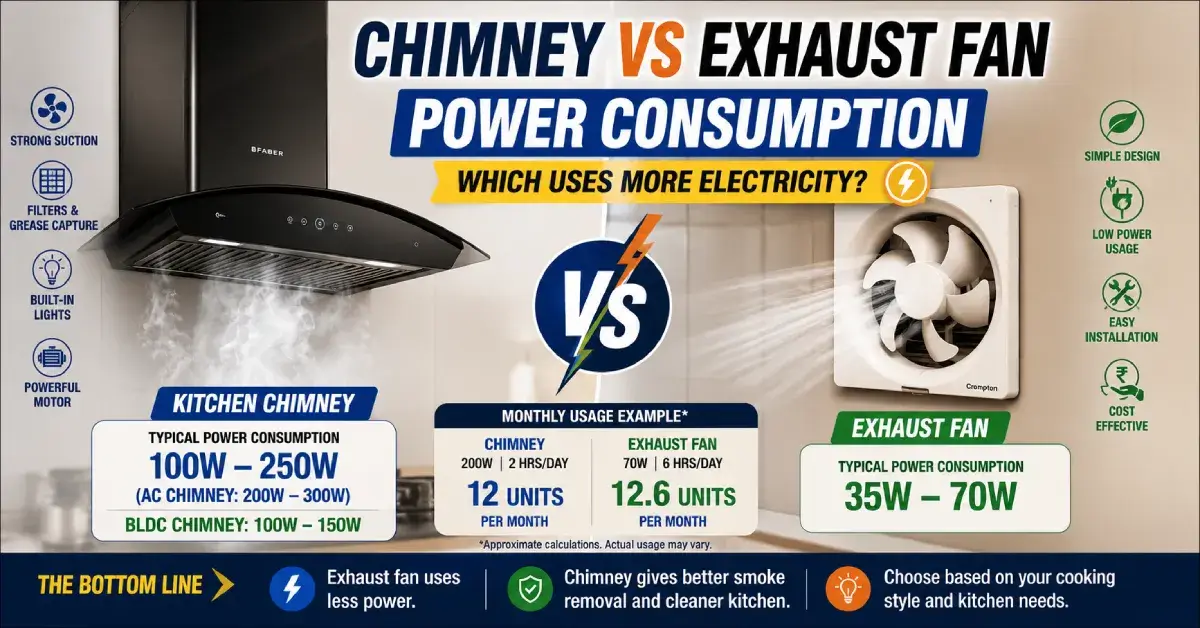
- Kitchen exhaust fan: usually around 35 to 70 watts in kitchen use
- Kitchen chimney: usually around 100 to 250 watts during operation
- BLDC chimney: often around 100 to 150 watts
- Auto-clean mode in chimneys: can increase power use by around 15% to 25%
So yes, a chimney usually draws more power than an exhaust fan. But a chimney also delivers much stronger airflow and captures smoke directly above the stove, which is why many Indian households still prefer it.
Quick Winner Guide
| Priority | Better Option |
|---|---|
| Lowest electricity bill | Exhaust fan |
| Better smoke removal | Chimney |
| Best balance | BLDC chimney |
| Heavy Indian cooking | Chimney |
| Lowest running cost | Exhaust fan |
| Better kitchen cleanliness | Chimney |
Typical Power Consumption Comparison
| Appliance | Typical Power Use |
|---|---|
| Small to medium kitchen exhaust fan | 35 to 70 watts |
| Average kitchen chimney | 100 to 250 watts |
| Standard AC chimney | 200 to 300 watts in many models |
| BLDC chimney | 100 to 150 watts |
| Chimney with lights and active functions | Can go higher depending on usage mode |
This tells you one clear thing: on a watt-to-watt basis, the exhaust fan is the lighter appliance.
Why a Chimney Uses More Power
A kitchen chimney is designed to do much more than an exhaust fan. It usually includes:
- a stronger suction motor
- filters for grease and odour
- focused air capture above the cooktop
- built-in lighting
- sometimes auto-clean heating
- multi-speed controls
- sensor or timer features in advanced models
Because of all this, it naturally consumes more electricity than a simple wall or window exhaust fan.
An exhaust fan is basically a straightforward ventilation device. It moves air out of the room, but it does not usually trap grease, filter cooking fumes, or create the same level of targeted suction over the stove.
Airflow Matters Too
Power consumption alone does not tell the full story.
A kitchen exhaust fan may handle roughly 200 to 300 m³/h airflow in many common use cases, while a kitchen chimney may deliver roughly 1000 to 1400 m³/h or more. That means the chimney usually consumes more power, but it also does far more work.
So the real comparison is not just:
- lower watts vs higher watts
It is also:
- lower suction vs higher suction
- basic ventilation vs source-level smoke capture
- room-level air movement vs focused grease and odour control
That is why many homeowners accept the higher power draw of a chimney.
Monthly Electricity Consumption Examples
To make this easier, let’s look at practical examples.
Example 1: Exhaust Fan
Suppose your kitchen exhaust fan is 70 watts and you use it for 6 hours a day.
- Daily use = 70 × 6 ÷ 1000 = 0.42 kWh
- Monthly use = 0.42 × 30 = 12.6 units
So a 70W exhaust fan running 6 hours daily uses about 12.6 units per month.
Example 2: Standard Chimney
Suppose your kitchen chimney is 200 watts and you use it for 2 hours a day.
- Daily use = 200 × 2 ÷ 1000 = 0.40 kWh
- Monthly use = 0.40 × 30 = 12 units
So a 200W chimney running 2 hours daily uses about 12 units per month.
Example 3: BLDC Chimney
Suppose your BLDC chimney is 100 watts and you use it for 2 hours a day.
- Daily use = 100 × 2 ÷ 1000 = 0.20 kWh
- Monthly use = 0.20 × 30 = 6 units
So a BLDC chimney can bring monthly usage down significantly.
Important Insight
This is where the comparison gets interesting.
Even though a chimney has higher wattage, it may not always create a much higher monthly bill than an exhaust fan if:
- the chimney runs for fewer hours
- the exhaust fan is left on for long stretches
- the chimney has auto shut-off or timer functions
- the chimney uses a BLDC motor
- the chimney removes smoke faster, so you switch it off sooner
So exhaust fan wins in raw power draw, but actual monthly usage can be closer than many people expect.
Which Uses More Power Per Hour?
If both appliances run for exactly one hour, the chimney usually uses more electricity.
A simple way to think about it:
- 50W exhaust fan for 1 hour = 0.05 units
- 150W chimney for 1 hour = 0.15 units
- 200W chimney for 1 hour = 0.20 units
So on a straight per-hour basis, the chimney clearly consumes more.
Which Is Cheaper to Run Monthly?
This depends on usage habits.
Exhaust fan may be cheaper if:
- you use a low-watt model
- your kitchen is small
- you cook lightly
- you run it as a basic ventilator
- you do not need grease filtration
Chimney may be reasonable to run if:
- you use it only while cooking
- your model has timer or sensor shut-off
- you choose a BLDC motor
- you need stronger smoke capture
- your cooking style produces grease and odour regularly
So the answer is:
Exhaust fan is usually cheaper in raw electricity cost
but
chimney may deliver more useful kitchen ventilation for the energy used
BLDC Chimney vs Exhaust Fan Power Consumption
BLDC chimneys have changed the comparison quite a bit.
Traditional chimneys are often in the 200 to 300 watt range, while many BLDC chimneys can operate closer to 100 to 150 watts for similar suction goals. That means the electricity gap between chimney and exhaust fan becomes narrower.
A BLDC chimney is a good choice if you want:
- lower monthly electricity use
- quieter operation
- better efficiency
- modern timer and sensor features
- stronger value over long-term use
If power consumption is one of your top concerns, a BLDC chimney is often the most sensible chimney type to consider.
Does Auto-Clean Increase Chimney Electricity Use?
Yes, it does.
Auto-clean mode can increase chimney power use by roughly 15% to 25%, depending on the model and how often you use the feature. That does not mean auto-clean is bad. It just means you should use it smartly rather than unnecessarily.
A good rule is:
- use normal suction mode daily as needed
- use auto-clean at practical intervals
- do not overuse heavy cleaning cycles if the chimney does not need them
Why Exhaust Fans Sometimes Waste Electricity Too
Many people assume exhaust fans are automatically more efficient just because they use lower wattage. That is not always true in real life.
An exhaust fan can waste electricity when:
- it is left running for long periods
- it runs at one constant speed only
- it is used in a large kitchen where it struggles to clear smoke
- it is poorly placed far from the cooking zone
- you still need to run it longer because smoke and smell linger
In contrast, a modern chimney may include:
- multiple speed settings
- timer shut-off
- sensor-based operation
- targeted suction directly above the stove
So although the chimney is a higher-watt appliance, it can sometimes be used more efficiently in practice.
Power Consumption vs Performance
This is the most important section for Indian users.
If your kitchen involves:
- tadka
- frying
- repeated sautéing
- masala roasting
- pressure cooking
- oily cooking
then the comparison should not be limited to power use alone.
A lower-power exhaust fan may save electricity, but if it does not remove grease and smoke properly, you may still end up with:
- smoky kitchen walls
- greasy cabinets
- stronger odour spread
- more cleaning
- less comfort during cooking
A chimney consumes more electricity, but it usually gives much stronger source-level extraction. For many Indian homes, that trade-off is worth it.
So Which One Is More Energy Efficient?
This depends on what you mean by energy efficient.
If you mean lower wattage:
Exhaust fan wins
If you mean better smoke removal per cooking session:
Chimney often wins
If you mean lower running cost with strong performance:
BLDC chimney is often the sweet spot
That is why the best answer is not one-size-fits-all.
Best Choice for Different Users
Choose an exhaust fan if:
- your top priority is lower electricity use
- you have a small kitchen
- your cooking is light
- you want the cheapest appliance to run
- you do not mind basic ventilation instead of advanced smoke capture
Choose a standard chimney if:
- you cook Indian food regularly
- you want grease and odour control
- performance matters more than the lowest wattage
- you are fine with slightly higher electricity use
Choose a BLDC chimney if:
- you want chimney-level performance with lower energy use
- you cook often
- you want timer and smart features
- you want better long-term efficiency
Common Misconception
Many buyers assume a chimney will dramatically increase the electricity bill.
👉 In reality, most chimneys run only during cooking, so monthly electricity usage is often lower than people expect.
Simple Formula to Calculate Power Consumption
You can calculate monthly electricity use with this formula:
Power Consumption (kWh) = Wattage × Hours Used ÷ 1000
Then multiply the daily result by 30 for monthly units.
Example
If a 150W chimney runs for 2 hours daily:
- 150 × 2 ÷ 1000 = 0.30 units per day
- 0.30 × 30 = 9 units per month
If a 50W exhaust fan runs for 5 hours daily:
- 50 × 5 ÷ 1000 = 0.25 units per day
- 0.25 × 30 = 7.5 units per month
This shows why a higher-watt appliance does not always create a dramatically higher monthly bill if used for fewer hours.
How to Reduce Chimney Power Consumption
If you choose a chimney and want to keep electricity use under control, follow these habits:
- choose a BLDC model if budget allows
- use the right speed instead of always using maximum mode
- clean filters regularly
- use auto shut-off or timer features
- do not leave the chimney running longer than needed
- use auto-clean only when required
- keep ducting efficient if you have a ducted model
These small habits can make a noticeable difference.
How to Reduce Exhaust Fan Power Consumption
If you use an exhaust fan, these steps help:
- choose the correct size instead of oversizing
- buy a motor-efficient model
- switch it off once ventilation is sufficient
- clean blades and grills regularly
- ensure proper placement for airflow efficiency
A poorly maintained fan may run longer for the same result.
Final Thought
If your question is “Chimney vs exhaust fan power consumption: which uses more electricity?”, the answer is clear:
A kitchen chimney usually consumes more electricity than an exhaust fan.
Typical comparison:
- exhaust fan: 35 to 70 watts
- chimney: 100 to 250 watts
- BLDC chimney: 100 to 150 watts
But if your real question is “Which gives better overall value in an Indian kitchen?”, then the answer depends on your cooking style.
- For lowest electricity use, go with an exhaust fan
- For better smoke, grease, and odour control, go with a chimney
- For stronger performance with better efficiency, go with a BLDC chimney
So the smartest conclusion is:
Exhaust fan is cheaper to run, but chimney is usually more effective.
And if power consumption is your concern but you still want chimney performance, BLDC chimney is usually the best middle path.
FAQs
Does a chimney consume more electricity than an exhaust fan?
Yes. In most cases, a chimney consumes more power because it has a stronger motor, focused suction, filters, lights, and sometimes auto-clean features.
What is the average wattage of a kitchen chimney?
A kitchen chimney commonly operates around 100 to 250 watts, while many traditional models can be around 200 to 300 watts. BLDC models are often lower.
What is the average wattage of a kitchen exhaust fan?
A kitchen exhaust fan commonly falls around 35 to 70 watts, depending on size and motor type.
Is chimney electricity bill very high?
Usually not. The wattage is higher than an exhaust fan, but monthly usage depends heavily on how many hours you use it each day. Many households use a chimney only during cooking.
Is a BLDC chimney worth it for saving electricity?
Yes, if you use the chimney regularly. BLDC models can reduce power consumption significantly compared with standard AC motor chimneys.
Does auto-clean mode increase power consumption?
Yes. Auto-clean can raise chimney power use by around 15% to 25%, so it should be used when needed rather than excessively.
Which is better for Indian cooking: chimney or exhaust fan?
For heavy Indian cooking, a chimney is generally better because it captures smoke and grease more effectively. For low-cost, basic ventilation, an exhaust fan is sufficient.