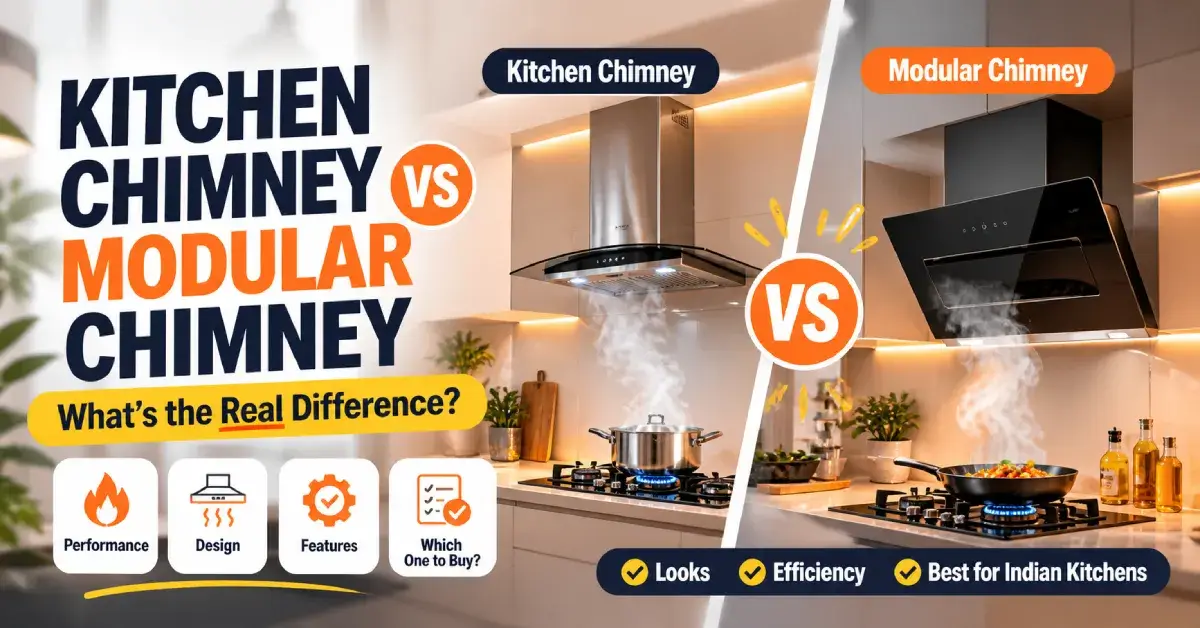

If you are comparing kitchen chimney vs modular chimney, the first thing to know is this: in most Indian buying conversations, these are not two completely different appliances. A kitchen chimney is the broad category for the appliance that removes smoke, grease, steam, and odour from the cooking zone. A modular chimney usually refers to a modern kitchen chimney designed to suit modular kitchens in terms of looks, fit, finish, and installation style. In other words, a modular chimney is usually just a type or style of kitchen chimney, not its opposite.
For many buyers, the confusion comes from showroom language. Retailers often use “modular chimney” to describe sleek wall-mounted, built-in, curved-glass, or designer chimneys that match modern cabinets and hobs. But functionally, both still do the same job: they sit above the cooking area and pull out smoke, heat, oil particles, and cooking smells.
So if your question is, “Which is better: kitchen chimney or modular chimney?” the honest answer is that the comparison is slightly misleading. A better question is: Do you need a basic chimney, or a chimney that integrates well with a modular kitchen design and layout?
Quick Answer
A kitchen chimney is the general appliance category, while a modular chimney is usually a modern, design-focused kitchen chimney meant for modular kitchens. If you have a modular kitchen, a modular chimney is usually the better fit because it looks cleaner, aligns better with cabinets and hobs, and is available in layouts like wall-mounted, built-in, and island styles. But in terms of core function, both remove smoke and fumes from your kitchen.
What Is a Kitchen Chimney?
A kitchen chimney is an appliance installed above a stove or hob to remove smoke, grease, steam, and odours generated while cooking. It improves kitchen hygiene, keeps cabinets cleaner, and helps make heavy Indian cooking more manageable indoors. Depending on the model, it can be ducted or ductless, wall-mounted, built-in, or island-style.
In Indian homes, kitchen chimneys are especially useful because cooking often involves tadka, frying, sautéing, grilling, pressure cooking, masala roasting, and oil-heavy recipes. These create more smoke and grease than light Western-style cooking, so a proper chimney can make a big difference to everyday comfort and long-term kitchen maintenance.
What Is a Modular Chimney?
A modular chimney is generally a modern kitchen chimney designed to suit a modular kitchen setup. That means it is chosen not only for suction performance, but also for space efficiency, cabinet compatibility, visual appeal, and layout integration. These chimneys often come in sleeker finishes such as black glass, stainless steel, angular bodies, touch controls, motion sensors, and compact built-in designs.
The phrase “modular chimney” is more about design context than technology. It does not mean the chimney uses a totally different ventilation principle. It still works like any kitchen chimney: a motor creates suction, smoke is captured above the cooking zone, grease is filtered or separated, and the air is either thrown out through a duct or cleaned and recirculated in ductless models.
Kitchen Chimney vs Modular Chimney: The Real Difference
The easiest way to understand this comparison is to think of it like this:
- Kitchen chimney = the general product category
- Modular chimney = a kitchen chimney designed for modular kitchen aesthetics and layouts
So this is not like comparing a chimney with an exhaust fan, or a hob with a gas stove. It is more like comparing a general term with a specific modern format inside that term.
Comparison Table
| Feature | Kitchen Chimney | Modular Chimney |
|---|---|---|
| Meaning | Broad term for kitchen smoke-removal appliance | A modern kitchen chimney suited to modular kitchens |
| Main purpose | Remove smoke, grease, steam, odour | Same purpose |
| Design focus | Can be basic or premium | Strong focus on aesthetics and cabinet integration |
| Best for | Any kitchen type | Modular kitchens and modern interiors |
| Common styles | Basic wall-mount, traditional hood, ducted/ductless | Wall-mounted, built-in, island, curved glass, designer finish |
| Visual appeal | Varies by model | Usually more premium and seamless |
| Installation planning | Standard | Often planned alongside cabinets, hob, and duct route |
| Performance | Depends on suction, filter, motor, ducting | Same—depends on specs, not the label alone |
This is why many people believe modular chimneys are “better,” when in reality they are often just better-looking and better integrated, not automatically more powerful. The actual performance still depends on size, suction power, filter design, motor quality, and installation quality.
Why the Term “Modular Chimney” Became Popular in India
The term became popular as modular kitchens became more common in urban Indian homes. As people shifted from standalone gas stoves and open shelves to built-in cabinets, granite counters, hobs, tall units, and concealed storage, they also wanted chimneys that matched the new look. That is where the phrase “modular chimney” gained traction.
In practice, when someone says “I want a modular chimney,” they usually mean one of the following:
- a chimney that matches a modular kitchen design,
- a slim or stylish wall-mounted chimney,
- a built-in chimney hidden under cabinets,
- an angled glass chimney for a modern look,
- or a chimney-hob combination that feels visually coordinated.
Is a Modular Chimney Better Than a Regular Kitchen Chimney?
A modular chimney is better only if your priorities include appearance, space planning, and seamless integration with cabinets and a built-in hob. If your only concern is removing smoke effectively, then a well-installed standard kitchen chimney with the right suction power can perform just as well.
That means the “better” option depends on what you value most:
Choose a modular chimney if:
You are building or renovating a modular kitchen, want a cleaner premium look, care about visual integration, and want a chimney style that matches modern cabinetry and countertop design.
Choose any good kitchen chimney if:
Your main goal is smoke and grease removal, and you are less concerned about designer styling or cabinet integration. In such cases, performance specs matter more than the “modular” label.
Types of Modular Chimneys You’ll See in the Market
When people talk about modular chimneys, they are usually referring to these popular designs:
1. Wall-Mounted Chimneys
These are the most common option in Indian homes. They are fixed against a wall above the hob or stove and are widely used in L-shaped and straight modular kitchens.
2. Built-In Chimneys
These are partially concealed inside cabinetry for a cleaner and more minimalist look. They are popular in premium modular kitchens where homeowners want the appliance to blend into the cabinet line.
3. Island Chimneys
These are suspended from the ceiling above a kitchen island. They are best for large open kitchens with an island hob setup.
4. Curved Glass and Angular Chimneys
These models are popular because they combine modern styling with decent headroom and easy access while cooking. They also work well visually in contemporary Indian kitchens.
These are still kitchen chimneys. The “modular” tag mainly reflects how they fit into modern kitchen planning.
Performance: Does a Modular Chimney Work Better?
Not automatically. A modular chimney is not superior just because it looks premium. Performance comes from a few core factors:
- chimney width,
- suction power,
- ducting quality,
- filter type,
- motor quality,
- and installation height above the hob.
For Indian kitchens, many guides recommend choosing suction power of around 1,200 m³/hr or higher, especially if you cook oily food frequently. Similarly, the chimney should ideally be equal to or slightly wider than the hob for better smoke capture. So a beautiful modular chimney with weak suction can underperform, while a simpler model with the right size and specs can work better.
Design and Aesthetics: Where Modular Chimneys Usually Win
This is the area where modular chimneys clearly stand out. They are often designed to match built-in hobs, glossy cabinets, minimalist wall units, and modern backsplashes. They help create the polished “modular kitchen” look that many homeowners want.
If your kitchen is already planned as a modular space, a bulky or outdated chimney design can break the visual flow. A modular chimney, by contrast, usually looks more intentional and cohesive. This is especially important in open kitchens where the cooking zone is visible from the dining or living space.
Installation Planning: A Big Reason Modular Chimneys Feel Better
One of the biggest advantages of choosing a modular chimney during a kitchen renovation is that the appliance can be planned along with the cabinets, hob position, electrical points, and duct path. That leads to a cleaner result and often better performance too.
In many older kitchens, chimneys are added later, and that can lead to awkward duct bends, poor placement, visible pipes, or mismatched height. With a modular kitchen setup, the chimney is usually part of the overall plan from the start, which helps with both looks and usability.
Kitchen Chimney vs Modular Chimney for Indian Cooking
For Indian cooking, what matters most is not whether the chimney is called modular, but whether it is correctly sized and properly installed. Indian cooking creates strong odours, spice-heavy fumes, and oil-laden vapours, so buyers should focus on practical things like suction power, maintenance ease, and service support.
That said, modular chimneys are often a smart choice for Indian homes because they combine modern design with features that suit everyday use, such as auto-clean technology, motion sensors, touch controls, and compact layout compatibility. So while “modular” does not guarantee stronger suction, it often aligns with the kind of features people now want in urban Indian kitchens.
How to Choose the Right Option
If you are confused between the two, use this simple rule: buy based on kitchen type and usage, not the label.
You should focus on these factors first:
1. Kitchen layout
If you have a modular kitchen with fitted cabinets and a built-in hob, a modular chimney usually makes more sense visually and practically.
2. Chimney size
A chimney should be the same width or slightly bigger than the hob. In many Indian homes, 60 cm suits smaller setups and 90 cm suits 3- to 5-burner hobs or larger kitchens.
3. Suction power
For frequent Indian cooking, around 1,200 m³/hr or more is commonly recommended.
4. Ducted vs ductless
A ducted chimney generally performs better because it throws smoke outside. A ductless chimney may be easier to install where duct routing is difficult.
5. Maintenance
Some filters need regular cleaning or replacement. Auto-clean models may be easier for busy families.
6. Service support
After-sales service matters more than many buyers expect. Local service availability, warranty clarity, and quarterly maintenance options can affect long-term ownership experience.
Common Myths About Modular Chimneys
Myth 1: Modular chimney means more powerful chimney
Not necessarily. Power depends on suction, motor, and ducting quality, not on whether the product is described as modular.
Myth 2: A modular chimney is a totally different appliance
No. It is still a kitchen chimney. The term mainly highlights style, layout compatibility, and modern kitchen integration.
Myth 3: Only modular kitchens need chimneys
Even non-modular kitchens can benefit from a chimney if you cook frequently and want to reduce smoke, grease, and odour buildup.
Myth 4: A stylish chimney is enough
Looks matter, but installation quality, correct size, and suction power matter more for real-world performance.
Which One Should You Buy?
If your kitchen is being newly designed or renovated in a modular format, you will usually be happier with a modular chimney, because it will fit the overall look better and can be planned more intelligently with your cabinets and hob.
If you already have a functioning kitchen and only need a chimney for smoke control, then you do not need to chase the “modular” label. Just buy a kitchen chimney with the right width, suction power, and support network.
So the final answer is simple: a modular chimney is usually a subtype of kitchen chimney, not a competing alternative. Buy a modular chimney for style and integration. Buy any good kitchen chimney for function. Ideally, buy one that gives you both.
FAQs
Is there any real difference between a kitchen chimney and a modular chimney?
Yes, but mostly in terminology and design context. A kitchen chimney is the general appliance category, while a modular chimney usually refers to a chimney selected for a modular kitchen setup with a stronger focus on aesthetics and built-in compatibility.
Is a modular chimney worth it for Indian homes?
It is worth it if you want a modern look, better cabinet integration, and a cleaner kitchen layout. But you should still prioritize suction, size, and installation quality over branding language.
Can I use a regular kitchen chimney in a modular kitchen?
Yes. As long as the size, suction, and installation suit your setup, a regular kitchen chimney can work in a modular kitchen. The difference is that a modular chimney may look more seamless.
Does modular chimney mean built-in chimney?
Not always. A modular chimney can be wall-mounted, built-in, angular, curved-glass, or island-style. “Modular” is broader than just “built-in.”
Which size chimney is best for a modular kitchen?
That depends on the hob width. In many Indian kitchens, 60 cm works for smaller setups, while 90 cm is preferred for larger hobs and heavier cooking. The chimney should usually be equal to or slightly larger than the hob.
Final Verdict
If you are searching for kitchen chimney vs modular chimney, the most important takeaway is that this is not a true one-versus-one comparison. A modular chimney is usually just a modern kitchen chimney designed for modular kitchens. The real buying decision should be based on your kitchen layout, cooking style, chimney size, suction power, and installation planning.
For most modern Indian homes, especially newly designed kitchens, a modular chimney is the smarter choice because it delivers both function and appearance. But if your priority is purely smoke removal, then any properly sized kitchen chimney with good suction can do the job well.