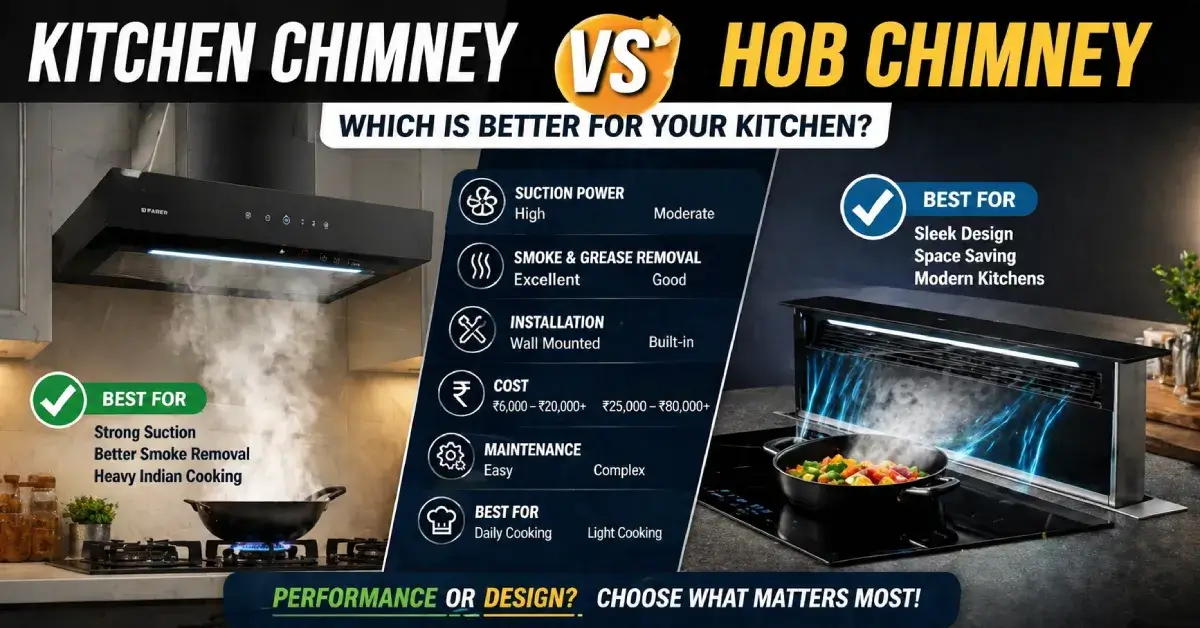

Quick Answer: A kitchen chimney and a hob are not the same appliance, so this is not really a direct “vs” comparison. A hob is the cooking surface with burners, while a kitchen chimney is the ventilation system above it that removes smoke, steam, odour, oil, and grease from the kitchen. In most modern modular kitchens, they are complementary appliances that work together, not substitutes
A lot of people search for “kitchen chimney vs hob chimney” when they are planning a modular kitchen, but the phrase is slightly confusing. In most cases, what people actually want to understand is one of these:
- What is the difference between a hob and a chimney
- Whether a hob needs a chimney
- Whether a hob + chimney combo is better than a normal stove setup
- Or how to choose the right hob and chimney combination
So let’s clear this up first: a hob is used for cooking, and a chimney is used for ventilation. One makes the food; the other keeps the kitchen cleaner while you cook.
If your readers are setting up a new kitchen, the smarter question is not kitchen chimney vs hob chimney but rather:
Do I need only a hob, only a chimney, or a hob and chimney together?
That is exactly what this guide answers.
What Is a Hob?
A hob is a cooking appliance installed on or into the kitchen counter. It acts as the main cooking surface and is available in different formats such as gas hobs and induction hobs. Unlike a freestanding gas stove, a hob is designed to look sleek and integrated with the kitchen platform, which is why it is popular in modular kitchens.
In simple terms, the hob is where your vessels sit and the cooking happens.
What Is a Kitchen Chimney?
A kitchen chimney is the ventilation appliance installed above the stove or hob. Its job is to remove smoke, steam, odour, oil, and grease generated during cooking. Depending on the model, it may use ducting to throw polluted air out or filters to trap grease and recirculate cleaner air.
In simple terms, the chimney is what keeps the kitchen from becoming smoky, sticky, and greasy.
So What Is a “Hob Chimney”?
There usually isn’t a separate appliance category called a hob chimney in everyday Indian kitchen buying language. Most of the time, people use the phrase to mean either:
- a chimney installed above a hob, or
- a hob and chimney combination for a modular kitchen.
That is why many home-improvement guides discuss hobs and chimneys together, because they are typically planned as a pair.
Kitchen Chimney vs Hob: The Real Difference
| Feature | Hob | Kitchen Chimney |
|---|---|---|
| Main purpose | Cooking | Ventilation |
| Installed where | On/in the counter | Above the hob or stove |
| Handles smoke? | No | Yes |
| Handles grease? | No | Yes |
| Used during cooking? | Yes, directly | Yes, as support |
| Needed for modular look? | Often yes | Often yes |
| Improves air quality? | No | Yes |
This is the biggest takeaway: a hob cooks, a chimney cleans the cooking environment. They are different appliances with different jobs.
Why Hobs and Chimneys Are Usually Bought Together
Modern Indian kitchens increasingly use a hob + chimney combination because it looks cleaner, works efficiently, and fits the modular kitchen aesthetic. Housing.com notes that chimneys and hobs “make the perfect pair” and work well in tandem. Beyond Appliances also describes the hob as the cooking surface and the chimney as the “lungs of your kitchen,” showing how they function together as one system.
In practical use:
- the hob produces the heat, smoke, and cooking fumes,
- while the chimney removes them.
That is why many homeowners upgrading to a modular kitchen plan both at the same time.
Can You Use a Hob Without a Chimney?
Yes, you can — but it is usually not ideal, especially for Indian cooking. Housing.com specifically says a hob can be used without a chimney, but recommends against it because the chimney helps push out oil and keep the kitchen clean.
If someone cooks lightly, has a small kitchen, or already has strong natural ventilation, they may still manage without a chimney. But if the kitchen sees daily tadka, frying, pressure cooking, or masala-heavy cooking, the absence of a chimney usually means:
- more smoke in the kitchen,
- more grease on tiles and cabinets,
- more odour build-up,
- and a generally messier cooking environment.
Can You Use a Chimney Without a Hob?
Yes. A chimney can be installed above a regular gas stove too. It does not require a built-in hob to work. So if someone already has a normal freestanding gas stove and only wants better ventilation, they can install a kitchen chimney without changing the stove to a hob.
That means a hob is not mandatory for a chimney — but a chimney becomes more useful when cooking is frequent and the kitchen needs better smoke and grease control.
Which One Should You Prioritise First?
If someone is building a kitchen from scratch, the ideal solution is usually to plan the hob and chimney together so sizes and layout are matched properly. But if the buyer is upgrading one appliance at a time, the priority depends on the pain point.
Prioritise the chimney first if:
- the kitchen gets smoky,
- cabinets become greasy,
- odours spread into the house,
- or the current cooking setup already works fine.
Prioritise the hob first if:
- the current stove is old, unsafe, or inconvenient,
- the modular kitchen layout needs an integrated cooktop,
- or the user wants a cleaner counter design and better burner layout.
That said, the best experience usually comes when both are selected together as a matched combination.
How to Match a Hob and Chimney Properly
One of the most important points in hob-and-chimney buying is size compatibility.
Housing.com recommends that the chimney should be slightly bigger than the hob, or at least the same size. A smaller chimney over a larger hob is not effective. It specifically notes:
- 90 cm chimney is recommended for 3, 4, or 5 burner hobs
- 60 cm chimney is recommended for 2 to 4 burner hobs
That means the chimney should cover the full cooking zone so smoke does not escape from the edges.
Simple size rule
- Small hob → same-size or slightly larger chimney
- Large hob → never pair with a smaller chimney
How to Choose the Right Hob
When choosing a hob, the most important things are size, number of burners, burner layout, burner material, and compatibility with your cooking style. Housing.com notes that common hob sizes include 2 ft, 2.5 ft, and 3 ft, and warns that choosing a hob that is too large for the kitchen can make the platform feel cluttered. It also recommends enough spacing between burners for safe, comfortable Indian cooking.
Beyond Appliances adds that the type of hob also matters:
- Gas hobs offer instant flame control and work with all cookware
- Electric hobs offer consistent heating
- Induction hobs are efficient and precise
So the “best” hob depends on whether the buyer prefers traditional gas cooking or modern induction-style performance.
How to Choose the Right Chimney for a Hob
A chimney should be selected based on the hob size, cooking style, suction power, and ducting setup. Housing.com says that a good chimney helps improve ventilation, extend the life of kitchen finishes, and remove oil, grease, and smell from the kitchen. It recommends around 1,200 m³/hr suction capacity as a useful benchmark and explains the difference between:
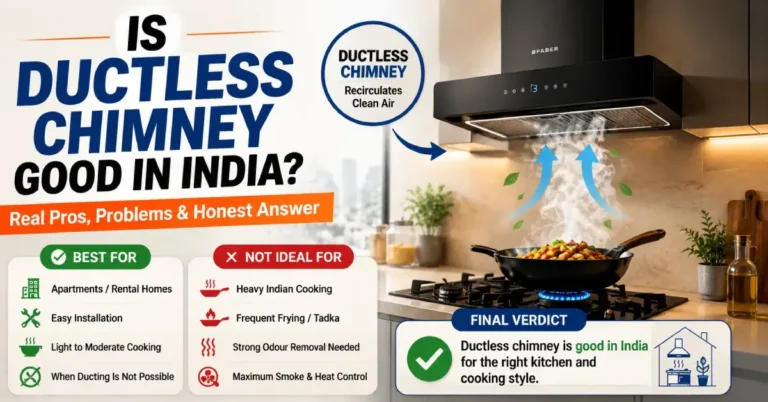
- duct chimneys, which throw smoke and oil outside, and
- ductless chimneys, which trap grease and recirculate air.
For Indian kitchens, where oil, butter, ghee, and masala are common, after-sales service and regular maintenance matter a lot too.
Is a Hob Better Than a Normal Gas Stove?
This is a slightly different comparison, but it often sits behind the “hob chimney” search. A hob is usually chosen because it gives a cleaner, sleeker, more built-in look compared to a regular freestanding stove. Housing.com says a normal stove is movable and free-standing, while a hob is fixed into the kitchen platform and looks more integrated.
So if the user’s real question is “Should I move from a regular gas stove to a hob and chimney combo?”, the answer is usually:
- Choose a hob + chimney combo for a modern modular kitchen and cleaner look
- Stick with a regular stove + chimney if budget and flexibility matter more
Who Should Buy Only a Chimney?
A buyer may only need a chimney if:
- they already have a decent gas stove,
- the kitchen gets smoky,
- the main problem is grease and odour,
- and they do not want to redo the platform for a built-in hob.
In these cases, installing a chimney alone can still make a big difference.
Who Should Buy a Hob + Chimney Combo?
A hob and chimney combination makes the most sense for:
- new modular kitchens,
- major kitchen renovations,
- open kitchens,
- heavy or daily Indian cooking,
- and homeowners who want a cleaner, more premium look.
Housing.com says the hob and chimney combination not only works well, but also adds a “wow look” to the kitchen. Beyond Appliances similarly frames the pair as essential to balancing functionality and style in contemporary kitchens.
When You May Not Need Both
Not every kitchen needs a hob and chimney. Housing.com explicitly notes that if the kitchen is small and cooking is limited, or if the household depends heavily on appliances like a microwave or air fryer, buying both may not offer good value for money.
That is an important nuance. A hob + chimney combo is not automatically the right answer for every home.
Common Mistakes People Make
1. Thinking the hob and chimney are alternatives
They are not. A hob is for cooking, while a chimney is for ventilation.
2. Buying a chimney smaller than the hob
This reduces smoke capture and makes the chimney less effective.
3. Choosing too many burners for a small kitchen
Housing.com warns that oversized hobs can make the platform look cluttered and reduce usable space.
4. Ignoring cooking style
If Indian cooking is heavy, suction power and layout matter more than just looks.
5. Not checking service and warranty
Both hob and chimney are long-term appliances, so after-sales support matters.
Final Thoughts
If your readers are comparing kitchen chimney vs hob chimney, the most accurate answer is this:
A hob and a kitchen chimney do different jobs, so one does not replace the other.
A hob is the cooking platform.
A chimney is the ventilation system.
In most modern Indian kitchens, especially modular ones, the best setup is usually a hob with a properly matched chimney. If the budget only allows one upgrade right now, the better starting point depends on the kitchen’s biggest problem:
- choose the chimney if smoke, grease, and odour are the issue,
- choose the hob if the current stove is the problem and ventilation is already manageable.
So the real winner is not “chimney vs hob.”
It is the right hob + chimney combination for your kitchen.
Frequently Asked Questions
What is the difference between a chimney and a hob?
A chimney is used for kitchen ventilation, while a hob is used for cooking.
Can I use a hob without a chimney?
Yes, but it is generally not recommended if you want better smoke and grease control.
Does a chimney have to be bigger than the hob?
Ideally yes. The chimney should be slightly bigger than the hob, or at least the same size.
Is a hob better than a normal gas stove?
A hob offers a more built-in, sleek look and integrates better with modular kitchens, while a normal gas stove is freer and easier to move.
Do all kitchens need both a hob and chimney?
No. Small kitchens with limited cooking may not need both.