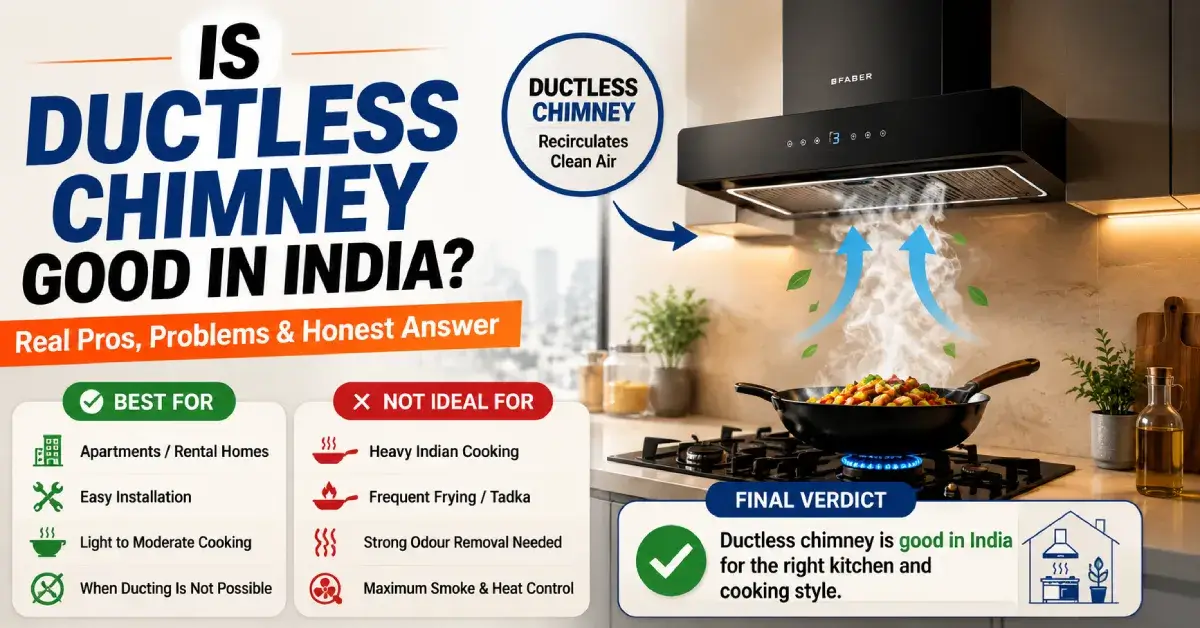

If you are wondering whether a ductless chimney is good in India, the short answer is: yes, but only for the right type of kitchen and cooking style.
A ductless chimney can be a good option for Indian homes where ducting is not possible, such as rented flats, small apartments, studio kitchens, or layouts where drilling an external outlet is difficult. It is easier to install, usually involves less civil work, and gives you a cleaner, more modern cooking setup than relying only on an exhaust fan.
However, it is not the best choice for every Indian kitchen. If your home has heavy daily cooking, frequent frying, strong tadka, deep masala roasting, or a lot of oil and smoke, a ductless chimney usually struggles compared to a ducted one. That is because it filters and recirculates air instead of throwing smoke and heat completely outside.
So the real answer is not “ductless chimney is good” or “ductless chimney is bad.” The real answer is this: a ductless chimney is good in India for light to moderate cooking and installation-limited homes, but not ideal for heavy Indian cooking in the long run.
Can a ductless chimney be enough in India?
Yes — for small kitchens and moderate cooking, a ductless chimney can work well. But for heavy frying and strong Indian cooking, a ducted chimney usually performs better.
Quick Answer
A ductless chimney is a good option in India if:
- you live in a flat or rental home
- you cannot make a duct outlet
- you want easy installation
- your cooking is light to moderate
- you are willing to replace carbon filters regularly
A ductless chimney is usually not the best option if:
- you cook oily Indian food every day
- your kitchen gets smoky very fast
- you want maximum odour removal
- you want lower long-term maintenance
- you can install a proper ducted chimney instead
Best Choice by Situation
| Situation | Recommendation |
|---|---|
| Rental flat | Ductless chimney |
| Heavy Indian cooking | Ducted chimney |
| No duct outlet | Ductless chimney |
| Open kitchen | Ducted chimney |
| Light cooking | Ductless chimney |
| Strong odour control needed | Ducted chimney |
What Is a Ductless Chimney?
A ductless chimney is a kitchen chimney that does not use an external duct pipe to throw smoke outside. Instead, it pulls in smoky air, passes it through filters, and then releases the cleaned air back into the kitchen.
In simple terms:
- a ducted chimney removes smoke from the kitchen
- a ductless chimney cleans the air and sends it back into the kitchen
Most ductless chimneys use a combination of:
- grease filters or baffle-style filtration
- activated carbon or charcoal filters for odour control
This is why ductless chimneys are often called recirculating chimneys.
How Well Does a Ductless Chimney Work in Indian Kitchens?
This depends on how you cook.
Indian cooking often produces:
- strong smells from onion, garlic, and whole spices
- oil fumes from frying and tadka
- steam from pressure cooking and boiling
- greasy residue from regular masala cooking
A ductless chimney can definitely reduce smoke, grease particles, and odour, but it usually cannot remove them as completely as a ducted chimney. Since the air is recirculated, some heat, moisture, and smell remain in the kitchen.
That means ductless chimneys work reasonably well for:
- light everyday cooking
- small families
- apartments with limited ventilation options
- homes where appearance and convenience matter
- people who cook once or twice a day without much frying
But they are often less satisfying for:
- heavy North Indian tadka cooking
- frequent deep frying
- fish, meat, or high-smoke cooking
- large families cooking multiple times a day
- open kitchens where odours spread quickly
Advantages of a Ductless Chimney in India
1. Easy Installation
This is the biggest reason many people consider ductless chimneys.
A ductless chimney does not need:
- a long duct pipe
- wall core cutting
- complicated route planning
- major civil work
That makes it ideal for apartments where making an outlet hole is difficult or not allowed. If you are living in a rented flat, this can be a major benefit.
2. Good for Apartments and Rental Homes
In many Indian apartments, kitchen walls do not conveniently open to the outside, or society rules make structural changes difficult. A ductless chimney becomes useful in such situations because it gives you better smoke control than having no chimney at all.
If your options are:
- no chimney
- only an exhaust fan
- or a ductless chimney
then a ductless chimney can still be a worthwhile upgrade.
3. Cleaner Look for Modern Kitchens
A ductless chimney can help maintain a neat, modern kitchen look without visible duct pipes. This is attractive for modular kitchens, compact layouts, and urban homes where design matters.
4. Lower Initial Installation Hassle
While the appliance itself may not always be dramatically cheaper, the overall setup is often simpler. You avoid many ducting-related expenses and complications.
For homeowners who want a quick kitchen upgrade without renovation mess, ductless is appealing.
5. Flexible Placement
Since you are not dependent on a duct route to the outside wall, placement is easier. This gives more flexibility during kitchen planning.
Problems With Ductless Chimneys in India
1. Not Ideal for Heavy Indian Cooking
This is the biggest limitation.
Indian kitchens often generate thick oily fumes and strong odours. A ductless chimney can filter part of this, but it does not fully throw the smoke, hot air, and moisture outside. So the kitchen may still feel warm, smell of cooking, or need extra ventilation.
If your cooking includes daily frying, repeated tadka, or strong masala dishes, ductless usually feels like a compromise.
2. Carbon Filter Replacement Adds Ongoing Cost
A ductless chimney depends heavily on carbon or charcoal filters. These filters do not last forever. They need periodic replacement, and that creates an ongoing maintenance cost.
This is one reason many people find ductless chimneys convenient initially but more expensive over time than expected.
3. Odour Removal Is Limited
A ductless chimney can reduce smell, but it usually does not remove strong odours as effectively as a ducted model. This matters a lot in:
- studio apartments
- open kitchens connected to the living room
- homes where people cook fish, eggs, garlic-heavy food, or spicy tadka often
If odour removal is your top priority, ductless is usually not the best answer.
4. Heat and Steam Stay Indoors
Because the air comes back into the kitchen, heat and humidity are not fully expelled. During summer or during long cooking sessions, the kitchen can still feel stuffy.
This is one of the clearest practical differences between ductless and ducted chimneys.
5. Performance Depends Heavily on Maintenance
A ductless chimney only works well if:
- grease filters are cleaned regularly
- carbon filters are changed on time
- the motor and airflow are kept unobstructed
If maintenance is delayed, performance drops quickly. Many buyers expect “fit and forget,” but ductless chimneys do not work that way.
So, Is Ductless Chimney Good in India?
The most accurate answer is:
Yes, if your kitchen fits these conditions
A ductless chimney is good in India if you have a small or medium kitchen, cook light to moderate food, live in a flat or rented home, and cannot install a ducted model.
No, if your kitchen needs strong extraction
A ductless chimney is not the best choice if your home has heavy Indian cooking, large family meals, frequent frying, or an open kitchen where smoke and smell travel easily.
So instead of asking whether it is good or bad in general, ask:
Is it good for my kitchen, my cooking style, and my installation limits?
That is the right buying question.
Who Should Buy a Ductless Chimney in India?
A ductless chimney makes sense for:
Apartment owners with no duct outlet option
If external wall access is difficult, ductless may be the most practical chimney solution.
Renters
If you do not want major drilling or permanent modifications, ductless is far easier to manage.
Light or moderate cooks
If your meals are simple and you do not fry heavily every day, the performance may be good enough.
Small families
A 1- to 3-person household with limited cooking intensity may be perfectly happy with a ductless chimney.
Buyers prioritising convenience over maximum extraction
If easy setup matters more to you than top-end smoke removal, ductless is a reasonable compromise.
Who Should Avoid a Ductless Chimney?
You should probably skip ductless if:
- you cook multiple heavy meals daily
- you do frequent deep frying
- your kitchen fills with smoke fast
- you want the kitchen to stay cooler during cooking
- you are very sensitive to food smells
- you own the house and can install a ducted model properly
In those cases, ducted is generally the better long-term option.
Ductless Chimney vs Exhaust Fan
Some people compare a ductless chimney with an exhaust fan because both are chosen when full ducted chimney installation is difficult.
A ductless chimney is usually better than a basic exhaust fan when it comes to:
- capturing fumes closer to the cooking source
- reducing grease particles
- improving the overall kitchen look
- offering more focused smoke control above the stove
But an exhaust fan can still be helpful for:
- moving heat out of the kitchen
- supporting cross ventilation
- lowering cost
In many Indian homes, a ductless chimney can work best when paired with good natural ventilation or an exhaust fan. That way, the chimney filters fumes while the kitchen still gets help pushing heat and stale air out.
Cost of Owning a Ductless Chimney in India
Many buyers think only about purchase price, but total ownership cost matters more.
A ductless chimney may save money on:
- duct installation
- core cutting
- pipe accessories
- civil work
But over time, you may spend more on:
- carbon filter replacement
- periodic servicing
- reduced efficiency if filters are delayed
- possible upgrades later if performance feels insufficient
So the right question is not just, “Is ductless cheaper?” The better question is, “Is ductless cheaper for my full 3- to 5-year usage?”
For many light users, yes. For heavy cooks, not always.
Maintenance Requirements
Ductless chimneys need disciplined maintenance.
A simple routine looks like this:
Weekly
- wipe the exterior body
- clean visible grease marks
- check whether suction feels weaker than usual
Monthly
- clean grease filters or baffle sections as recommended
- wipe the inner accessible areas
- inspect oil collector if your model has one
Every few months
- inspect the carbon or charcoal filter
- replace it if odour control has dropped
- check whether smoke lingers longer than before
Annually
- get a proper service if the chimney is used frequently
- inspect motor performance and controls
A ductless chimney that is not maintained properly often becomes disappointing faster than a ducted one.
Is Ductless Chimney Good for Small Apartments in India?
Yes, this is one of the best use cases.
In a small apartment, buyers often face these issues:
- no convenient duct path
- no permission for wall cutting
- very limited kitchen space
- budget limits
- need for a simple plug-and-use setup
In such cases, a ductless chimney can be a very sensible solution. It offers better control than no chimney and can improve comfort significantly if cooking is moderate.
That said, if the apartment has an open kitchen connected to the living room, you should still be realistic. Strong odours may reduce, but not disappear fully.
Is Ductless Chimney Good for Daily Indian Cooking?
It depends on what “daily Indian cooking” means in your home.
Good enough for:
- dal, sabzi, roti, boiling, reheating
- light sautéing
- occasional shallow frying
- one or two meals a day for a small family
Usually not ideal for:
- repeated tadka
- deep frying
- fish or meat with strong smell
- heavy oil cooking
- commercial-style home kitchens
- large-family kitchens with long cooking hours
If your kitchen falls into the second group, ductless may feel underpowered or high-maintenance over time.
Common Myths About Ductless Chimneys
Myth 1: Ductless chimney is useless in India
Not true. It is not useless. It is simply more situational. It works best when ducting is not possible and cooking intensity is moderate.
Myth 2: Ductless chimney and ducted chimney perform the same
Also not true. Ducted models usually remove smoke, heat, and odour more effectively because they expel air outside.
Myth 3: Ductless chimney needs no maintenance
Wrong. In fact, filter care is one of the biggest ownership responsibilities in ductless systems.
Myth 4: Ductless chimney is always cheaper
Not necessarily. Installation may be cheaper, but recurring filter replacement can narrow the gap over time.
Final Verdict
So, is ductless chimney good in India?
Yes, a ductless chimney can be good in India if you choose it for the right reasons. It works best for:
- apartments
- rental homes
- kitchens where ducting is impossible
- light to moderate cooking
- buyers who want easy installation
- people who will maintain filters properly
But if you want the best possible performance for heavy Indian cooking, strong odour removal, and lower long-term hassle, a ducted chimney is usually the better option.
The smartest conclusion is this:
Ductless chimney is good in India as a practical compromise, not as the ideal choice for every kitchen.
If you treat it as a convenience-focused solution for installation-limited homes, it can be a good buy. If you expect it to perform exactly like a powerful ducted chimney in a heavy-use Indian kitchen, you may be disappointed.
One-Line Verdict
👉 Ductless chimney is best for convenience-focused homes where duct installation is difficult — not for heavy-duty Indian cooking.
FAQs
Is a ductless chimney worth buying in India?
Yes, it can be worth buying if your kitchen cannot support ducting and your cooking is light to moderate. It is especially useful in flats and rental homes.
Does a ductless chimney remove smell completely?
No, not completely. It can reduce odour, but it usually cannot match a ducted chimney for strong-smell cooking.
Is ductless chimney good for frying and tadka?
It can help, but it is usually not the best choice for frequent heavy frying or strong tadka-based cooking.
Can I use a ductless chimney in a rented flat?
Yes. This is one of the most common and practical use cases.
Does a ductless chimney need filter replacement?
Yes. Carbon or charcoal filters need periodic replacement for good odour control.
Is a ductless chimney better than no chimney?
In many homes, yes. If a ducted chimney is not possible, a ductless chimney is usually better than having no chimney at all.
Should I buy ductless or ducted chimney in India?
Buy ductless if ducting is difficult and your cooking is moderate. Buy ducted if you want stronger smoke and odour removal and can install external venting.