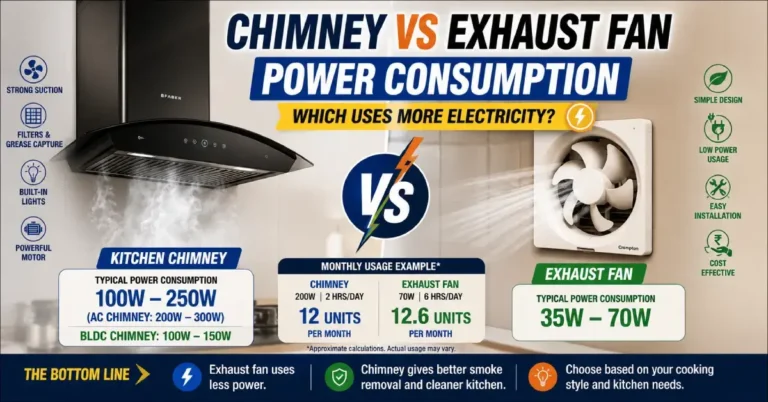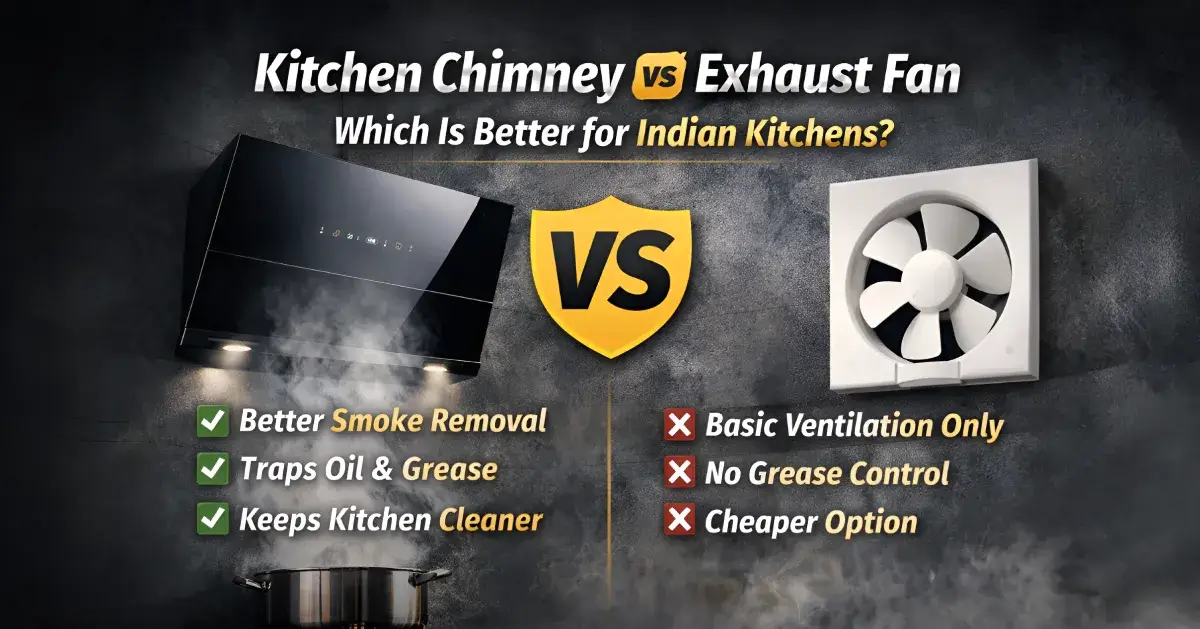

If you cook Indian food regularly — especially tadka, frying, grilling, or oily dishes — a kitchen chimney is usually the better option because it removes smoke, odour, grease, and heat more effectively. If you have a small kitchen, cook lightly, or want a low-cost ventilation solution, an exhaust fan can still work well.
| Situation | Best Option |
|---|---|
| Daily Indian cooking | Kitchen Chimney |
| Tight budget | Exhaust Fan |
| Modular kitchen | Kitchen Chimney |
| Small rented kitchen | Exhaust Fan |
| Frequent frying | Kitchen Chimney |
Many Indian homeowners face this exact question while planning or upgrading a kitchen: should you install a kitchen chimney or just use an exhaust fan?
At first glance, both seem to do the same job — remove smoke, steam, and heat. But in practice, they perform very differently. A chimney is designed to capture smoke, grease, odours, and airborne particles right above the cooktop, while an exhaust fan mainly helps move stale air, heat, and steam out of the kitchen. That difference matters a lot in Indian kitchens, where cooking often involves oil, masalas, high heat, and frequent frying.
This guide compares both options in a simple, practical way so your readers can decide what is actually better for their kitchen, cooking style, and budget.
What Is a Kitchen Chimney?
A kitchen chimney is installed above the gas stove or hob. It uses a motor and filters to pull in smoke, steam, heat, odour, oil, and grease particles generated while cooking. In ducted models, the polluted air is pushed outside; in ductless models, filters clean the air before recirculating it. Modern chimneys may also include auto-clean, touch controls, gesture controls, and LED lights.
What Is an Exhaust Fan?
An exhaust fan is a simpler ventilation appliance usually mounted on a wall or window. Its main job is to push out hot air, smoke, steam, and stale air from the kitchen. Unlike a chimney, it does not use filters to trap grease or oil particles, so while it improves airflow, it does not offer the same level of purification or grease control.
Kitchen Chimney vs Exhaust Fan: Key Difference in One Line
A chimney captures and filters cooking pollutants near the source, while an exhaust fan mainly ventilates the room by pushing air out
Kitchen Chimney vs Exhaust Fan: Side-by-Side Comparison
| Feature | Kitchen Chimney | Exhaust Fan |
|---|---|---|
| Smoke removal | More effective | Basic ventilation only |
| Grease control | Traps oil and grease particles | Does not filter grease |
| Odour removal | Better at removing odours | Less effective |
| Heat removal | Good | Good |
| Maintenance | Filters need cleaning/replacement | Blades and cover need cleaning |
| Installation | More complex | Easier |
| Cost | Higher upfront cost | Budget-friendly |
| Looks | Stylish, modern | Functional, basic |
| Best for | Heavy Indian cooking | Light cooking / small kitchens |
1. Smoke Removal: Which One Performs Better?
This is where the chimney clearly wins.
A kitchen chimney uses a powerful suction motor placed directly above the stove, so it captures smoke right where it is produced. That makes it far more effective during daily Indian cooking, especially when you are making tadka, frying onions, deep-frying snacks, or using multiple burners. Exhaust fans, by contrast, only circulate and expel air from a distance, so a lot of smoke may still spread inside the kitchen before it reaches the fan.
According to ContractorBhai, a ductable chimney can perform far better than an exhaust fan in Indian homes because it handles not just visible smoke but also food particles, oiliness, and heavier cooking fumes.
Winner: Kitchen chimney
2. Grease and Oil Control: The Biggest Practical Difference
This is the most important difference for Indian kitchens.
Indian cooking often produces oily vapours that settle on cabinets, tiles, false ceilings, and walls. A kitchen chimney is specifically built to deal with this problem because its filters help trap grease and oil particles before they spread around the room. An exhaust fan does not have this kind of filtration, so grease can still settle on surfaces over time.
ContractorBhai makes this point very clearly: in kitchens with cabinets above the platform, oily and masaledar cooking fumes can gradually make cabinets yellowish if only an exhaust fan is used. A chimney helps protect those surfaces much better.
Winner: Kitchen chimney
3. Odour Control: Which Keeps the Kitchen Fresher?
Kitchen chimneys are generally better at controlling odours because they pull cooking fumes through filters and remove them more efficiently. Exhaust fans help vent out stale air, but they are usually not as effective in handling strong cooking smells from garlic, fish, onion masala, frying oil, or tempering spices.
If someone cooks only occasionally or mostly boils, steams, or reheats food, an exhaust fan may feel sufficient. But for regular Indian cooking, a chimney does a noticeably better job.
Winner: Kitchen chimney
4. Cost: Which Is More Affordable?
An exhaust fan is clearly the cheaper option.
Exhaust fans are more budget-friendly to buy and easier to install. Chimneys come with motors, filters, controls, and often ducting requirements, so they cost more upfront and may need professional installation. Multiple sources describe exhaust fans as the more affordable solution, while chimneys are positioned as higher-cost but higher-performance appliances.
So if the user’s main concern is initial cost, the exhaust fan wins. But if the goal is better long-term cleanliness and cooking comfort, a chimney may justify the extra spend.
Winner: Exhaust fan
5. Installation: Which Is Easier?
Exhaust fans are much easier to install.
Most exhaust fans can be fitted into an existing wall opening or window space. Chimneys usually need wall mounting, electrical connection, and in many cases ducting or a recirculation setup. That makes installation more complex and sometimes more expensive.
If a homeowner wants a quick, low-hassle setup, an exhaust fan is simpler.
Winner: Exhaust fan
6. Maintenance: Which Is Easier to Manage?
This one depends on what kind of maintenance you are comparing.
Exhaust fans are simpler appliances, so maintenance is straightforward: clean the blades, cover, and housing regularly. Chimneys need more structured maintenance because filters may need washing or replacement, and annual servicing is often recommended.
However, there is an important practical twist. Even though the exhaust fan itself is simpler to clean, it does not stop grease from settling elsewhere in the kitchen. That means walls, cabinets, and nearby surfaces may need more cleaning. A chimney may require filter cleaning, but it can reduce the amount of grime that builds up around the kitchen.
Winner:
- Appliance maintenance only: Exhaust fan
- Overall kitchen cleanliness: Kitchen chimney
7. Noise: Which One Is Quieter?
A lot of buyers assume exhaust fans are quieter because they are simpler, but that is not always true. Faber notes that exhaust fans can be noisy and distracting, while many modern chimneys are designed for quieter operation. Atomberg also points out that better chimney motors and filter design can help distribute airflow more evenly and reduce noise.
That said, chimney noise varies by speed setting and model. A premium chimney can be quieter than a cheap exhaust fan, but a high-power chimney on max speed can still be noticeable.
Winner: Depends on model, but modern chimneys often have the advantage
8. Space and Aesthetics: Which Looks Better in a Modern Kitchen?
A chimney is usually the more attractive option.
Kitchen chimneys now come in curved glass, T-shape, angular, built-in, and designer finishes that can improve the look of a modular kitchen. Exhaust fans are mostly functional and unobtrusive, but they rarely add visual value. If the kitchen is part of an open-plan living area, a chimney usually fits the design much better.
Winner: Kitchen chimney
9. Indoor Air Quality and Health: Which Is Better?
Chimneys have a stronger case here.
Because they are designed to remove smoke, odour, grease, and other cooking pollutants more effectively, chimneys are generally better for indoor air quality. Faber specifically says chimneys are designed to remove smoke, carbon monoxide, and other toxic fumes more effectively than exhaust fans. Bajaj Finserv also notes that chimneys help improve indoor air quality by removing pollutants and reducing grease buildup.
In homes where cooking happens multiple times a day, this can make a meaningful difference.
Winner: Kitchen chimney
Which One Is Better for Indian Kitchens?
For most Indian kitchens, a kitchen chimney is the better long-term choice.
That recommendation comes up consistently across sources because Indian cooking usually involves stronger smells, more oil, more smoke, and more spice-heavy cooking than many Western kitchen setups. KAFF explicitly positions kitchen chimneys as the stronger solution for Indian kitchens because they handle smoke, heat, steam, oil, and grease more comprehensively. ContractorBhai also recommends chimneys for modern Indian homes, especially where modular cabinets need protection from greasy fumes.
Choose a kitchen chimney if:
- You cook Indian food daily
- You do frequent frying or tadka
- You have a modular kitchen
- You want better grease control
- You have an open or semi-open kitchen
- You want a cleaner, more premium kitchen setup
Choose an exhaust fan if:
- You have a very small kitchen
- You cook lightly or infrequently
- Your budget is tight
- You need basic ventilation only
- You live in a rented property and want a simple solution
Can an Exhaust Fan Replace a Chimney?
In some cases, yes — but not fully.
If the kitchen is small and cooking is light, an exhaust fan can be enough for basic ventilation. But it is not a true substitute for a chimney in a home that does regular Indian cooking. It can remove heat, steam, and some smoke, but it cannot handle grease and odours nearly as well.
So the better way to say it is this: an exhaust fan can be sufficient, but a chimney is usually superior.
Can a Chimney Replace an Exhaust Fan?
Yes, in most homes, a properly installed kitchen chimney can replace an exhaust fan because it removes smoke, odour, grease, and heat more effectively.
A chimney is installed directly above the cooktop, so it captures cooking fumes before they spread through the kitchen. In many modern Indian kitchens, homeowners use only a chimney and do not install an exhaust fan at all.
However, in very large kitchens or homes with heavy daily cooking, some people use both together for extra ventilation and faster heat removal.
👉 For most Indian households, a chimney alone is usually enough if it is correctly sized and installed.
Can You Use Both Together?
Some homeowners install both — a chimney near the cooktop and an exhaust fan elsewhere for extra ventilation. This can be useful in large kitchens, but for most homes, it is not necessary if the chimney is sized correctly and installed properly. Since the user intent here is informational, the practical advice is simple: start with the right chimney if your cooking is heavy; consider an exhaust fan only if you have special ventilation needs or a small-budget setup.
Pros and Cons of a Kitchen Chimney
Pros
- Better smoke removal
- Better odour control
- Captures grease and oil
- Helps keep cabinets and walls cleaner
- Improves indoor air quality
- Modern look and premium feel
- Can include useful features like auto-clean and LED lights
Cons
- Higher upfront cost
- More complex installation
- Filter cleaning/replacement required
- Needs enough wall space above the stove
Pros and Cons of an Exhaust Fan
Pros
- Affordable
- Easy to install
- Good for basic ventilation
- Works well in small kitchens
- Helps remove heat and moisture
- Takes up less space visually
Cons
- Poor grease control
- Less effective for strong odours
- Less effective for heavy cooking
- May lead to more grime on nearby surfaces
- Basic appearance
Who Should Buy What?
Choose Kitchen Chimney If:
✔ You cook Indian food daily
✔ You do frequent frying or tadka
✔ You have a modular or open kitchen
✔ You want better grease and odour control
Choose Exhaust Fan If:
✔ You cook lightly or occasionally
✔ You have a very small kitchen
✔ Your budget is limited
✔ You need only basic ventilation
Kitchen Chimney vs Exhaust Fan: Final Comparison
If your readers want the most honest conclusion, it is this:
A kitchen chimney is better than an exhaust fan for most Indian kitchens.
But an exhaust fan is still a practical budget choice for small kitchens and light cooking.
A chimney wins on performance, grease control, odour removal, air quality, and overall kitchen cleanliness. An exhaust fan wins on price, simplicity, and ease of installation. So the right choice depends on whether the priority is better cooking comfort or lower cost.
For a modern Indian home with regular daily cooking, a chimney is usually the smarter investment.
Frequently Asked Questions
Kitchen chimney vs exhaust fan: which is better?
For most Indian kitchens, a kitchen chimney is better because it removes smoke, grease, and odours more effectively. An exhaust fan is a better choice only if you have a small kitchen, light cooking, or a very limited budget.
Is a chimney better than an exhaust fan for Indian cooking?
Yes, in most cases. A chimney is better at handling smoke, grease, odours, and cooking fumes common in Indian kitchens.
Is an exhaust fan enough for a small kitchen?
Yes, it can be enough if the kitchen is small and the cooking is light. For heavy frying and oily cooking, a chimney is still better.
Which is cheaper: chimney or exhaust fan?
An exhaust fan is usually cheaper to buy and install.
Which needs more maintenance?
A chimney needs filter cleaning or replacement, while an exhaust fan needs blade and housing cleaning. But a chimney may reduce overall kitchen grime.
Does an exhaust fan remove grease?
Not effectively. It helps airflow, but it does not filter out grease the way a chimney does.