
If you are researching kitchen chimney electricity consumption, the short answer is that a kitchen chimney usually does not add a very high amount to your monthly bill, but the exact number depends on the motor type, suction level, auto-clean usage, lights, and how many hours you use it every day.
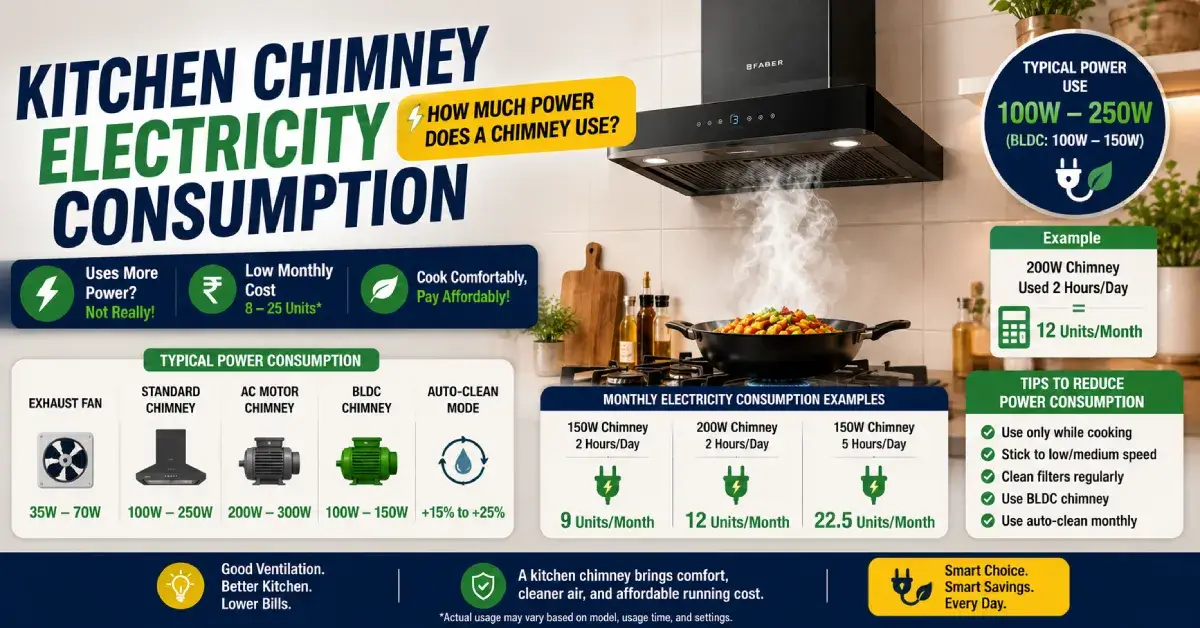
In most homes, a kitchen chimney typically operates in the range of 100 to 250 watts during normal use. Many standard models are often around 150 to 250 watts, while more efficient BLDC chimneys can run closer to 100 to 150 watts. If you use auto-clean mode, electricity use can increase by around 15% to 25% during that function.
So, if your main concern is whether a kitchen chimney consumes “too much” electricity, the answer is usually no. For most households, it is a manageable appliance in terms of power use, especially when compared with the comfort it provides by removing smoke, grease, and cooking odours.
How much electricity does a kitchen chimney use?
Most kitchen chimneys consume around 100 to 250 watts, with monthly electricity usage commonly falling between 8 and 25 units depending on usage habits.
Quick Answer
Here is the simplest version:
- Typical kitchen chimney power use: 100 to 250 watts
- Many standard AC models: 200 to 300 watts
- BLDC chimney power use: 100 to 150 watts
- Typical monthly consumption: around 8 to 25 units, depending on usage
- Auto-clean mode: may add 15% to 25% more power during cleaning
- Example: a 200W chimney used 2 hours a day consumes about 12 units per month
That means a chimney usually costs far less to run than many people expect.
Quick Monthly Cost Snapshot
| Chimney Type | Approx Monthly Usage | Estimated Cost* |
|---|---|---|
| 150W chimney (2 hrs/day) | 9 units | ₹54–₹90 |
| 200W chimney (2 hrs/day) | 12 units | ₹72–₹120 |
| BLDC chimney | Lower usage | Better efficiency |
*Approximate cost based on local electricity tariff.
What Is Kitchen Chimney Electricity Consumption?
Kitchen chimney electricity consumption simply means the amount of electrical energy a chimney uses while operating. This includes power used by:
- the suction motor
- the lights
- the control panel and smart features
- the auto-clean function, if available
Electricity consumption is measured in:
- watts for instant power draw
- kilowatt-hours or units for bill calculation
A chimney with a higher watt rating uses more power per hour, but your actual bill depends on how long it runs each day.
Typical Kitchen Chimney Wattage
Most kitchen chimneys fall into one of these general ranges:
Standard kitchen chimney
A regular kitchen chimney often uses around 120 to 250 watts for the motor, depending on suction power and design.
Chimney with lights and active functions
If the built-in lights are on and the chimney is running, total operating consumption can rise further. Some examples estimate around 250 watts of continuous operating power in practical use.
BLDC kitchen chimney
A BLDC chimney is generally more energy efficient and may consume around 100 to 150 watts while still offering strong suction.
Auto-clean mode
Auto-clean mode can increase electricity use by around 15% to 25%, especially during heat-based cleaning cycles.
Does a Kitchen Chimney Consume a Lot of Electricity?
For most households, no.
A kitchen chimney does consume more electricity than a small exhaust fan, but it is still not considered a heavy power-consuming appliance in normal household use. It usually runs for only a limited amount of time during cooking rather than all day.
That is why monthly usage often remains moderate unless:
- the chimney is used for long hours every day
- maximum speed is used for everything
- auto-clean runs too frequently
- filters are dirty and airflow becomes inefficient
In practical terms, a chimney is usually a medium-power appliance with moderate monthly usage, not a major electricity bill driver.
Common Buyer Myth
Many people assume a kitchen chimney dramatically increases the electricity bill.
👉 In reality, most chimneys run only during cooking, so monthly electricity use is often much lower than expected.
Average Kitchen Chimney Electricity Consumption Per Hour
To estimate hourly consumption, divide the wattage by 1000.
Here are some simple examples:
- 100W chimney for 1 hour = 0.10 units
- 150W chimney for 1 hour = 0.15 units
- 200W chimney for 1 hour = 0.20 units
- 250W chimney for 1 hour = 0.25 units
So if your chimney is rated at 150W and runs for two hours, it would consume about 0.30 units that day.
Monthly Electricity Consumption Examples
These examples make the numbers easier to understand.
Example 1: 150W chimney used 2 hours daily
- Daily consumption = 150 × 2 ÷ 1000 = 0.30 units
- Monthly consumption = 0.30 × 30 = 9 units
Example 2: 200W chimney used 2 hours daily
- Daily consumption = 200 × 2 ÷ 1000 = 0.40 units
- Monthly consumption = 0.40 × 30 = 12 units
Example 3: 150W chimney used 5 hours daily
- Daily consumption = 150 × 5 ÷ 1000 = 0.75 units
- Monthly consumption = 0.75 × 30 = 22.5 units
This matches a common estimate where a 150W chimney used 5 hours a day comes to 22.5 units per month.
Monthly Cost Estimate
If you want to convert units into rupees, use this formula:
Monthly Cost = Monthly Units × Electricity Rate
For example, if your chimney uses 22.5 units per month and your electricity rate is ₹6 per unit:
- 22.5 × 6 = ₹135 per month
If your local tariff is higher, the number increases. If your chimney runs only 1 to 2 hours daily, the cost may be noticeably lower.
Typical Monthly Consumption Range
A practical range often used for kitchen chimneys is:
- 8 to 25 units per month
This depends on:
- chimney wattage
- daily run time
- motor efficiency
- use of auto-clean mode
- speed setting
- maintenance condition
For a normal home kitchen, this is usually not a very large electricity burden.
Factors That Affect Kitchen Chimney Electricity Consumption
1. Motor Type
Motor type is one of the biggest factors.
AC motor chimneys
Traditional AC motor chimneys are common, but they can use more electricity. Many such models fall around 200 to 300 watts.
BLDC motor chimneys
BLDC chimneys are more efficient and often use around 100 to 150 watts. They can offer 40% to 50% energy savings compared with older AC motor models.
If electricity use matters to you, BLDC is usually the first thing to check.
2. Suction Power
Higher suction usually needs more power. If you constantly run the chimney at its top speed, consumption will naturally rise.
A chimney does not always need turbo mode. For light cooking like boiling milk or making tea, a lower speed is often enough.
3. Daily Usage Hours
A chimney used for 1 to 2 hours daily will cost much less to run than one used for 4 to 5 hours every day.
Usage time has a direct impact on your monthly bill.
4. Auto-Clean Function
Auto-clean is convenient, but it uses extra power. In many cases, the increase is around 15% to 25% during the cleaning cycle.
That does not mean you should avoid it. It simply means you should use it sensibly rather than unnecessarily.
5. Lights
Built-in LED lights also consume electricity, though usually not a very high amount. Some examples estimate about 25 watts per light, with two lights adding around 50 watts in total when switched on.
6. Filter Condition and Maintenance
A dirty chimney is often a less efficient chimney.
When grease blocks filters or airflow paths:
- the motor works harder
- power use can rise
- suction performance drops
- you may end up using higher speed for longer
Regular cleaning helps maintain both performance and efficiency.
7. Kitchen Layout and Duct Resistance
In ducted chimneys, longer duct routes, sharp bends, and airflow resistance can make the motor work harder. A better duct design often improves efficiency.
Kitchen Chimney Electricity Consumption: Standard vs BLDC
This is one of the most useful comparisons for buyers.
| Chimney Type | Typical Power Use | Key Benefit |
|---|---|---|
| Standard AC chimney | 200 to 300 watts | Common and widely available |
| Mid-range regular chimney | 120 to 250 watts | Balanced everyday use |
| BLDC chimney | 100 to 150 watts | Lower electricity use and better efficiency |
A BLDC chimney is usually the better option if you:
- cook often
- care about electricity savings
- want quieter performance
- prefer modern features like timers and smoother speed control
Is Auto-Clean Chimney Electricity Consumption High?
Not usually high enough to become a major problem, but it is definitely higher than normal operation during the cleaning cycle.
Auto-clean can increase power use by 15% to 25%, so the smartest approach is:
- use suction mode normally during cooking
- run auto-clean when needed
- avoid excessive cleaning cycles just because the feature exists
Used properly, auto-clean improves convenience without creating an unreasonable electricity cost.
How to Calculate Kitchen Chimney Power Consumption
Use this simple formula:
Power Consumption in Units = Wattage × Hours Used ÷ 1000
Then multiply by the number of days in a month.
Example
If your chimney is 180W and you use it 2.5 hours daily:
- Daily consumption = 180 × 2.5 ÷ 1000 = 0.45 units
- Monthly consumption = 0.45 × 30 = 13.5 units
That is your approximate monthly electricity usage.
How to Reduce Kitchen Chimney Electricity Consumption
The good news is that chimney usage can often be reduced significantly with better habits.
1. Choose a BLDC Chimney
This is the biggest upgrade if low electricity use is a priority. BLDC models can reduce consumption by 40% to 50% compared with traditional AC motor models.
2. Use the Right Speed
Do not use maximum speed for every cooking task. Lower speed is enough for lighter cooking.
3. Clean Filters Regularly
A clean filter reduces motor strain and keeps suction effective.
4. Use Auto-Clean Strategically
Run it when needed, not excessively.
5. Use Timer and Auto Shut-Off Features
Timer-based shut-off prevents the chimney from running longer than necessary.
6. Turn It On Early
Starting the chimney a couple of minutes before cooking can establish airflow, which may help the system work more efficiently.
7. Maintain Good Ducting
If you have a ducted chimney, efficient duct layout helps reduce resistance.
Can Smart Features Reduce Electricity Consumption?
Yes, in many cases.
Features that can help include:
- motion sensor controls
- auto turn-off timer
- usage tracking
- predictive maintenance alerts
- speed control based on actual cooking needs
These features help reduce unnecessary run time, which is often one of the easiest ways to lower electricity use.
Some estimates suggest that good usage habits plus efficient technology can cut chimney power consumption by 30% to 50% without compromising performance.
Is a Kitchen Chimney Expensive to Run?
For most homes, no.
A kitchen chimney is usually not an expensive appliance to run, especially if:
- you use it only while cooking
- you choose an efficient model
- you keep it clean
- you use proper speed settings
In fact, for many families, the monthly cost of running a chimney is quite reasonable relative to the benefits of better air quality, less grease buildup, and a more comfortable kitchen.
Who Should Choose a BLDC Chimney?
A BLDC chimney is ideal if:
✔ you cook daily
✔ you want lower electricity consumption
✔ you prefer quieter operation
✔ you plan long-term usage
Final Thought
If you are searching for kitchen chimney electricity consumption, here is the bottom line:
A kitchen chimney typically uses around 100 to 250 watts, with many standard models running around 150 to 250 watts and more efficient BLDC models around 100 to 150 watts. In most homes, monthly electricity use falls around 8 to 25 units, depending on how long the chimney runs and which features are used.
So, a kitchen chimney does consume electricity, but it usually does not consume as much as many buyers fear.
If you want the best balance of performance and savings:
- choose a BLDC chimney
- use proper speed levels
- clean filters regularly
- avoid unnecessary auto-clean use
- make use of timer and shut-off features
In simple terms:
Kitchen chimney electricity consumption is moderate, manageable, and usually worth it for the comfort and cleanliness it adds to an Indian kitchen.
FAQs
How much electricity does a kitchen chimney consume per month?
A kitchen chimney typically consumes around 8 to 25 units per month, depending on wattage, usage hours, and motor type.
What is the average wattage of a kitchen chimney?
Most kitchen chimneys operate in the range of 100 to 250 watts, though some standard AC models can be around 200 to 300 watts.
Does a kitchen chimney increase the electricity bill a lot?
Usually no. For most households, the increase is moderate and manageable, especially when the chimney is used only during cooking.
How much power does a BLDC chimney use?
A BLDC chimney often uses around 100 to 150 watts, which is lower than many traditional AC motor chimneys.
Does auto-clean mode consume more electricity?
Yes. Auto-clean can increase power use by around 15% to 25% during the cleaning cycle.
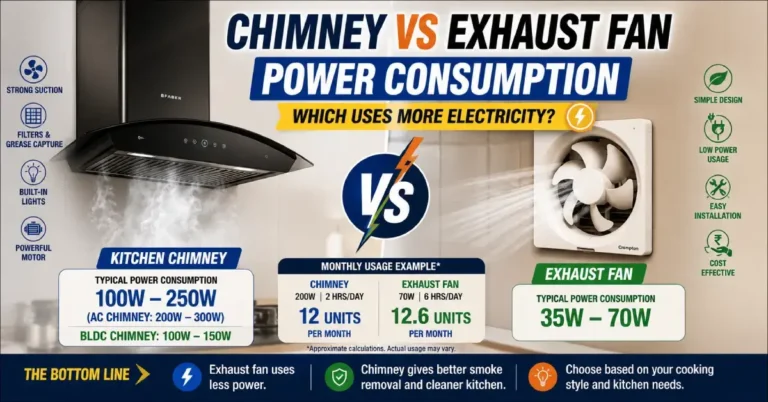
Is chimney electricity consumption higher than an exhaust fan?
Yes. A chimney usually consumes more electricity than an exhaust fan because it has a stronger motor, focused suction, lighting, and additional functions.
How can I reduce kitchen chimney power consumption?
Choose a BLDC model, clean filters regularly, use the correct speed, avoid unnecessary auto-clean use, and use timer or auto shut-off features.